"How many napkins should we order?" is usually decided by instinct: order the same as last time, or order enough to "be safe". Both approaches cost money. Order too much and you tie up cash and warehouse space. Order too little and you end up buying at retail — several times the wholesale price.
A napkin is cheap per unit, but you get through tens or even hundreds of thousands of them a year. At that scale, the difference between "roughly" and "precisely" is real money on the year-end books. This guide shows you how to calculate actual demand, set the right ordering frequency and size your stock so you never run out — and nothing sits in the warehouse longer than it should.
Why an accurate demand estimate is money
Ordering napkins looks like a trivial operational task. In reality it is a decision about cash flow, warehouse use and the unit price you actually pay.
The cost of ordering too much
An oversized order feels safe, but it carries hidden costs:
- Frozen cash — money spent on six months of stock is money you can't spend elsewhere.
- Warehouse space — a pallet of napkins takes up room that is expensive and limited in a hospitality venue.
- Damage risk — paper absorbs moisture and odours. Napkins held too long in a damp store lose their look and freshness.
- A locked-in design — if you rebrand or change format, you are stuck with stock you can't use.
The cost of running out
Underestimating hurts faster and harder:
- Emergency retail purchase — when you run out on a Friday night, you buy at the supermarket for several times the manufacturer's price.
- A break in service standards — no napkins, or a sudden switch to a random substitute, is a signal of chaos that guests notice.
- Buying under time pressure — under pressure you don't negotiate price or compare offers. You pay whatever it costs on the day.
An accurate demand estimate isn't an exercise in precision for its own sake. It's how you buy cheaper, less often and with less stress. We explore the mechanics of overpaying in why restaurants overpay for napkins.
How many napkins does one guest use? Baselines
Every calculation starts with consumption per guest. It varies widely by venue type, napkin format and how napkins are served (on the table, in a basket, in a dispenser).
The table below gives planning baselines — figures to start from before you calibrate them with your own data.
| Venue type | Napkins per guest | Dominant format |
|---|---|---|
| Café / patisserie | 2–3 | 24×24 cm, 15×15 cm |
| Bar / pub | 3–4 | 24×24 cm cocktail |
| Fast food / self-service | 4–6 | 33×33 cm 1/8D (dispenser) |
| Bistro / lunch | 3–4 | 33×21 cm, 33×33 cm |
| À la carte restaurant | 2–3 | 33×33 cm 2–3 ply |
| Catering / banquet | 3–5 | 33×33 cm 3 ply |
| Hotel breakfast / buffet | 3–4 | 24×33 cm |
| Food truck / street food | 4–6 | 24×24 cm, 33×33 cm 1/8D |
These numbers are not laws of physics but planning assumptions. A cocktail bar with fast drink turnover will exceed the upper bound. A fine-dining room using cloth napkins for the main course will fall below it. Your best baseline is your own usage: divide the napkins used last month by the guests served, and you get the real coefficient for your venue.
The formula for monthly demand
Once you know consumption per guest, the rest is arithmetic. Calculate monthly demand with a simple formula:
Monthly demand = guests per day × napkins per guest × opening days per month × (1 + buffer)
The buffer (usually 10–15%) covers waste, seasonal spikes and small estimation errors. Better a modest surplus than an emergency top-up.
Example: a café
- 250 guests per day (counter service plus takeaway)
- 3 napkins per guest
- 30 opening days per month
- 10% buffer (multiplier 1.1)
Calculation: 250 × 3 × 30 × 1.1 = about 24,750 napkins per month, or roughly 297,000 units a year.
A café gets through more napkins per customer than a restaurant, because customers take them from the counter themselves and grab-and-go generates consumption independent of use. Why that happens, and how to cost the counter separately from the tables, is in the guide to café and bakery napkins.
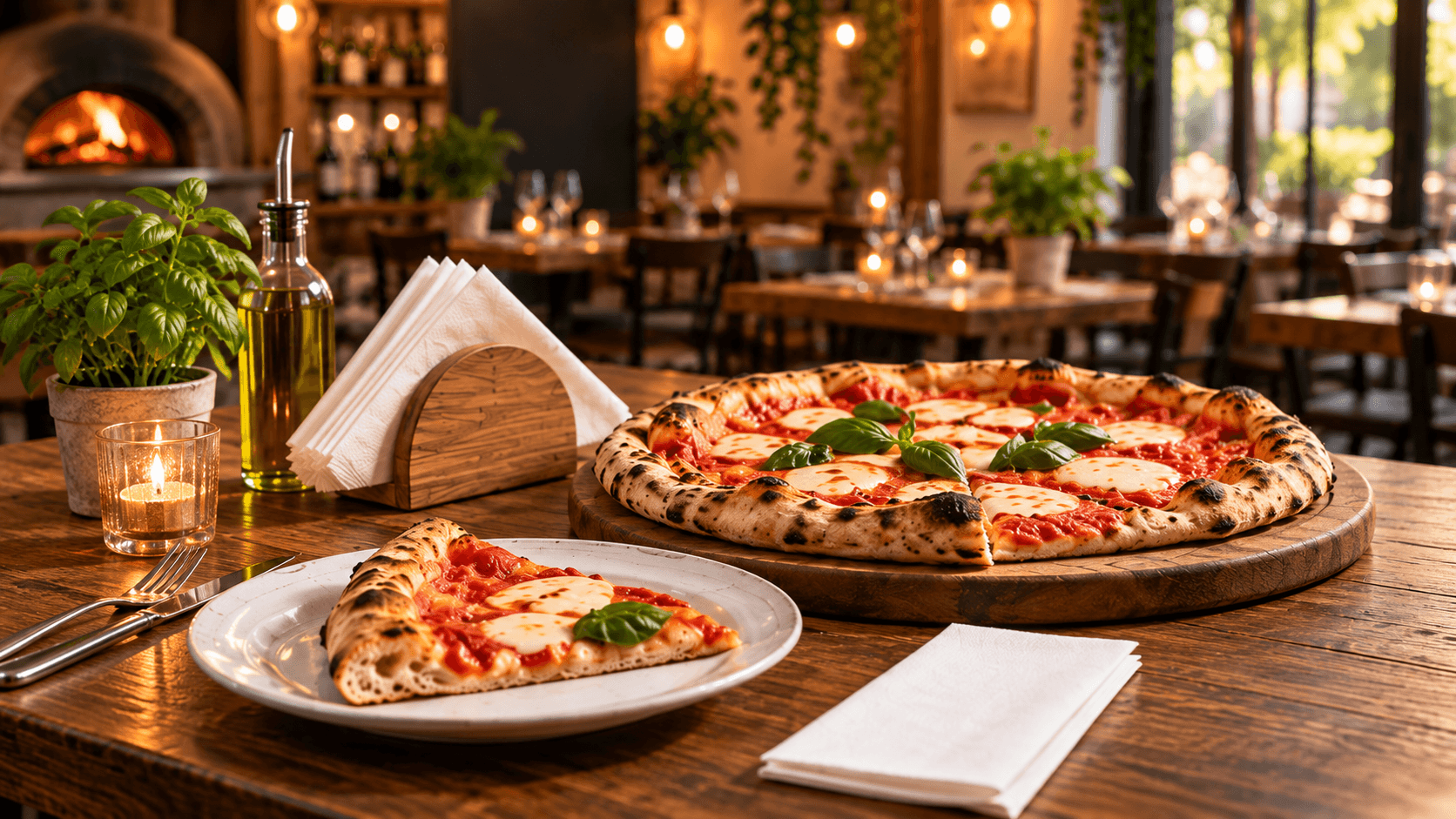
In a pizzeria the unit is not the guest but the order converted into people, because in delivery the number is set by whoever packs the box, not by the customer. How to count the room and delivery separately is in the guide to napkins for pizzerias.
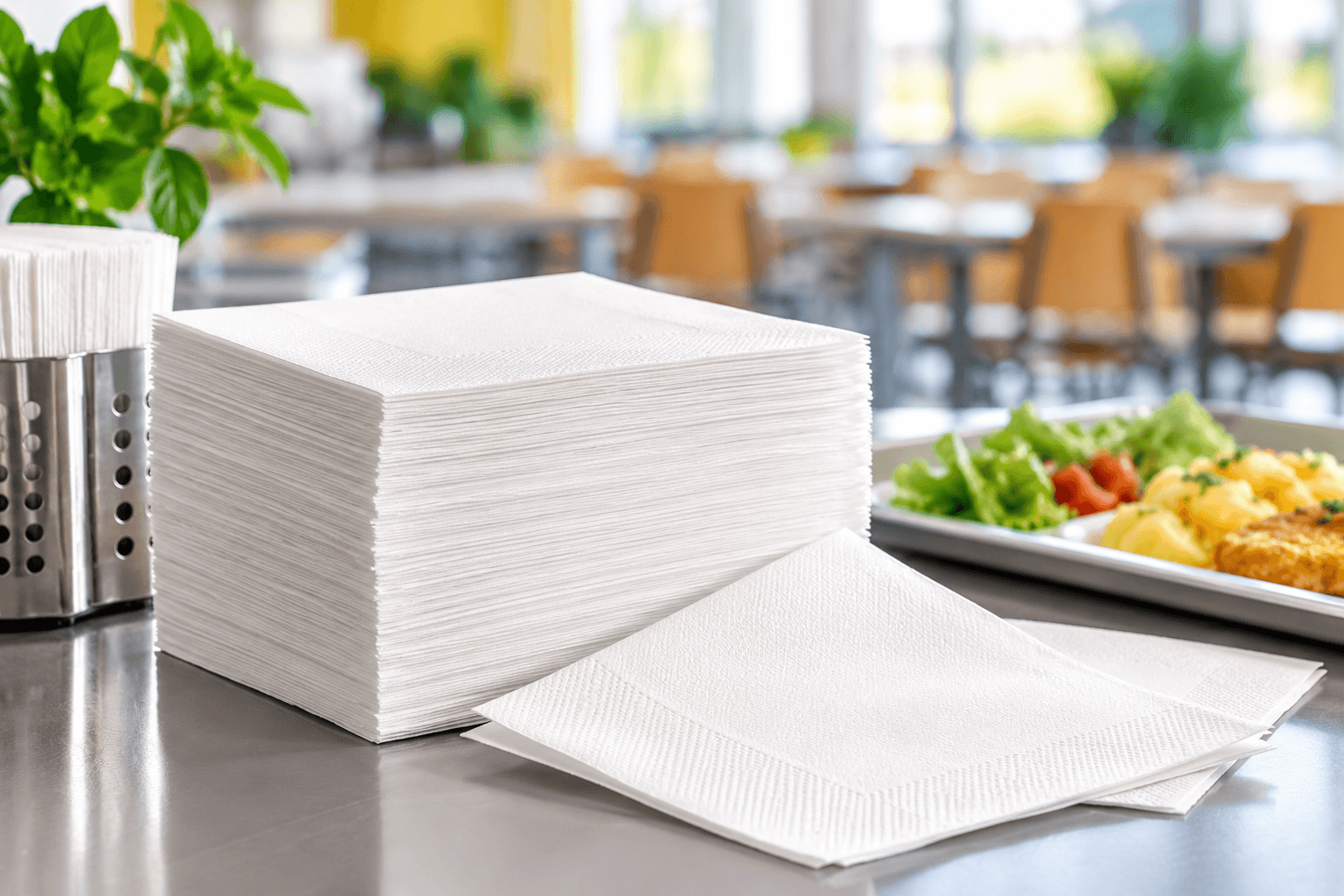
In a canteen the unit shifts again, because the number per cover is set by the operator laying sheets on the tray or at the cutlery station. How to work in cost per meal served instead of price per thousand is in the guide to napkins for canteens.
Example: an à la carte restaurant
- 150 covers per day
- 3 napkins per cover (place setting, replacement with the main course, service)
- 30 opening days
- 15% buffer (multiplier 1.15)
Calculation: 150 × 3 × 30 × 1.15 = about 15,500 napkins per month, or roughly 186,000 units a year.
With the annual figure, convert it into an ordering frequency. A quarterly order for the café above is about 74,000 units — a volume at which you negotiate a pallet price directly with the manufacturer. For choosing format and quality to match the calculation, see our paper napkin buying guide.
What really drives napkin consumption
Two venues with the same guest count can burn through napkins at completely different rates. Before you close the calculation, check which of these factors apply to you:
- Napkin format — a larger napkin is often one instead of two. Too small a napkin forces the guest to reach for another. We cover format selection in our article on paper napkin sizes.
- Number of plies — a thin single-ply is often grabbed two or three at a time "just in case". An absorbent two-ply genuinely reduces the number of grabs. See the comparison in 1-ply vs 2-ply napkins.
- How they're served — loose napkins in an open basket disappear faster than those dispensed one at a time.
- Guest profile — hands-on dishes (burgers, ribs, seafood) multiply consumption compared with cutlery meals.
- Table turnover — the faster guests rotate, the more full covers you serve per day.
- Seasonality — terrace season in summer, weddings from May to September, conferences in autumn, Christmas parties in December. Spikes can be tens of percent.
- Waste and pilferage — napkins taken by the handful "to go" are a real line item, especially in self-service.
The seasonal calendar repeats across most European markets: terrace season opens in spring, weddings run from May to September, conference and event bookings peak in autumn, and December belongs to corporate dinners and Christmas parties. Street-food venues add summer festivals and markets on top. If you serve any of these segments, plan the larger order at least a month ahead — especially for printed napkins, where production alone takes up to two weeks.
Consumption by venue type — a planning table
Below is a full worked example for different venue types. The values are illustrative — they show the method, not a standard. Plug in your own numbers and you get a starting point for an order.
| Venue type | Guests / day | Napkins / guest | Days / month | Monthly demand (10% buffer) |
|---|---|---|---|---|
| Café | 250 | 3.0 | 30 | ~24,750 |
| Bar / pub | 200 | 3.5 | 26 | ~20,000 |
| Fast food (dispenser) | 500 | 5.0 | 30 | ~82,500 |
| Bistro / lunch | 150 | 3.5 | 24 | ~13,900 |
| À la carte restaurant | 150 | 3.0 | 26 | ~12,900 |
| Catering (monthly avg.) | 350 | 4.0 | 12 | ~18,500 |
| Hotel — breakfast | 250 | 3.5 | 30 | ~28,900 |
Note the "days per month" column. For catering you count events and average guests per event, not opening days. A hotel breakfast runs 30 days, but you tie guest numbers to occupancy, not room count. We expand on napkins for hotel zones in paper napkins for hotels.
How format and dispensers change the maths
Demand in units is one thing. Real cost per guest is another — and here format and the serving method decide.
A dispenser is the simplest way to cut consumption in self-service venues. It physically forces a single-napkin grab instead of a handful from an open holder. In practice it cuts usage by 20–30%, which often lowers cost per guest despite the higher unit price of a folded napkin. The 33×33 cm 1/8D dispenser format is in the dispenser napkins category.
Format works the other way. Too small a napkin for messy food means two grabs instead of one — the seemingly cheaper unit costs more per meal. For classic hospitality, the 33×33 cm format works well; we've gathered the full range in the gastronomic napkins category.
Practical conclusion: calculate cost per guest, not price per unit. A napkin that costs more per piece but is taken singly can be cheaper over a month than a cheap one taken three at a time.
Stock planning: safety stock, reorder point, lead time
You know monthly demand — now set up a system that keeps you off zero. Three elements: lead time, reorder point and safety stock.
Lead times
Orders aren't filled overnight, especially with print. Indicative napkin lead times are:
| Order type | Production | Delivery (PL) | Delivery (DE / CZ) | Delivery (rest of EU) |
|---|---|---|---|---|
| Plain white, no print | 3–5 days | 1–2 days | 2–3 days | 5–7 days |
| 1-colour print | 5–7 days | 1–2 days | 2–3 days | 5–7 days |
| 2–3-colour print | 7–14 days | 1–2 days | 2–3 days | 5–7 days |
Logo napkins therefore need genuine lead time — from order to delivery at the door of an EU venue can be up to two weeks with multi-colour print. When planning an event or a season, order with time to spare.
The reorder point
The reorder point is the stock level at which you place the next order. Calculate it as:
Reorder point = average daily usage × lead time in days + safety stock
For the café above (about 24,750 units / 30 days ≈ 825 per day), with a 5-day delivery and 25% safety stock:
- usage during delivery: 825 × 5 = 4,125 units
- safety stock: 25% → about 1,030 units
- reorder point ≈ 5,150 units
When stock drops to about 5,150 units, you order — the new batch arrives before the current one runs out. For organising the purchase itself, see our buying guide.
How much to order wholesale? Carton, pallet, turnover
Calculating in units is the theory. In practice you order in bulk packs and pallets, and the manufacturer sets a minimum order quantity (MOQ). Three rules reconcile the calculation with logistics:
- Count in units, order in packs. First establish annual and monthly demand in units, then convert to cartons and pallets per the specific SKU spec. Units per carton depend on format and plies — always ask for it at the quote stage.
- Round up to a full pallet if it lowers the price. A full pallet usually means a better rate and cheaper transport per unit — but only if you have somewhere to store it and turn the stock over in reasonable time.
- Match frequency to turnover. For most venues, a 1–3 month order is optimal. Less often = better price and less admin; more often = less frozen cash and space. Find the balance for your warehouse.
At larger volumes it's worth discussing an ongoing partnership and a contract price list rather than one-off orders. We expand on wholesale buying in wholesale napkins, and you'll find B2B terms on the B2B cooperation page.
How to track real napkin consumption
The best calculation rests on data, not gut feeling. Tracking consumption doesn't need an ERP system — a simple, repeatable habit is enough:
- Opening and closing stock counts — count stock on the first and last day of the month, add the deliveries in between. The difference is your real usage.
- A simple spreadsheet — one column for deliveries, one for the monthly count. After two or three months you have a reliable trend instead of a single reading.
- Tie it to POS guest numbers — divide monthly usage by the covers recorded in your point-of-sale system. You get a per-guest coefficient that you refresh each quarter.
- A quarterly review — compare the forecast with reality and adjust the buffer. If 20% of the order regularly remains, lower it; if you keep running short, raise it.
Even a rough monthly count beats ordering "by eye". After a quarter of tracking, your orders stop being guesswork and become a decision grounded in numbers.
The most common napkin-ordering mistakes
Even a good calculation won't help if you repeat the classic ordering mistakes:
- Ordering "same as last time" without review — occupancy, menu and season change, but the order stays the same.
- Comparing price per unit instead of cost per guest — the cheapest napkin taken three at a time is often the most expensive over a month.
- No safety stock — one full-house weekend and an emergency retail run wipe out a whole quarter's savings.
- Ignoring lead time for print — ordering logo napkins a week before a wedding is an order that won't arrive in time.
- Over-stocking "because it was on offer" — six months of stock in a damp warehouse means frozen cash and quality risk.
- Fragmented orders across many suppliers — consolidating with one manufacturer means simpler accounting and a better price. We explain the case for buying from the manufacturer in producer vs importer.
Checklist: set your own order step by step
Pull it all into one repeatable process. For each new order you just update the numbers:
- Measure real consumption per guest — divide last month's napkins used by guests served.
- Calculate monthly demand — guests per day × napkins per guest × opening days × (1 + 10–15% buffer).
- Account for seasonality — add a correction for terraces, weddings, conferences or holidays if they apply to you.
- Set the ordering frequency — a 1–3 month cycle is optimal for most venues.
- Determine the reorder point — average daily usage × lead time + safety stock.
- Convert units into packs and pallets — ask the manufacturer for units per carton and cartons per pallet for your SKU.
- Order ahead of time — especially for printed napkins (up to 14 days' lead time).
Don't want to run the numbers yourself? Send us your venue type, average occupancy and preferred format — we'll prepare a demand estimate and a quote matched to your turnover. Write via the contact form or check the terms of B2B cooperation. As a manufacturer, we supply napkins directly from the factory — with no intermediaries and no importer margins.