TL;DR for the busy
Five takeaways:
- Ply choice is a cost decision, not an aesthetic one. A thin napkin used twice costs more than a thick napkin used once.
- Price per 1,000 isn't comparable when consumption differs by 2×. Measure cost per cover, not per pack.
- The optimal strategy is a mix. 1-ply in bar dispensers and back-of-house, 2-ply on the table.
- In casual dining (ticket >€12), 2-ply is cheaper over a year by 15–25%, despite the higher unit price.
- In fast food and bars, 1-ply wins by 25–35% – provided you use a dispenser.
Ply, gsm, absorbency – three terms operators routinely confuse
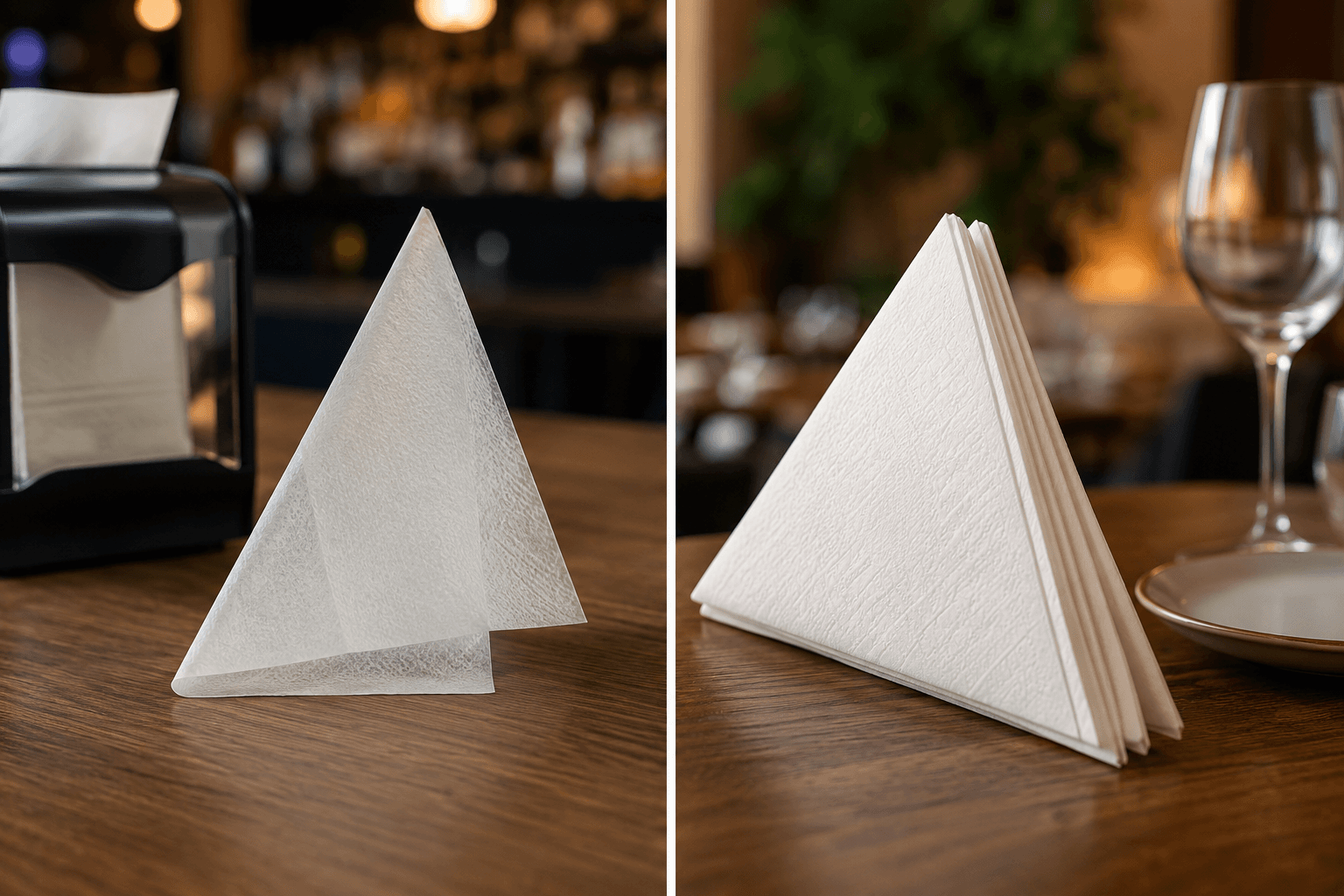
Ply. The number of tissue layers mechanically bonded together. 1-ply = a single sheet. 2-ply = two sheets joined by embossing.
GSM (grams per square metre). Total mass per square metre. Standard 1-ply: 16–19 gsm. Standard 2-ply: 32–38 gsm. This describes the sum – two thin sheets can match the weight of one thick sheet but behave differently in use.
Absorbency. Liquid absorbed per gram, in ml/g. This doesn't scale linearly with weight – pulp quality and embossing pattern affect it more than mass alone.
> Key definition: "2-ply 36 gsm" is not the same as "1-ply 36 gsm." Layered construction adds 35–50% to absorbency at the same total weight.
Why ply is a business decision
Most operators pick napkins on a single variable: price per 1,000 pieces. It's a mistake that can cost an average restaurant €450–1,000 a year – with no visible difference to the guest. Ply count isn't a cosmetic detail; it's an operational parameter that drives real cost per cover, monthly consumption and perceived venue quality.
This article breaks the decision into concrete numbers, use cases and business scenarios. No "you might consider" – specific thresholds, venue types and euro figures.
Full technical comparison: 1-ply vs 2-ply
| Parameter | 1-ply | 2-ply |
|---|---|---|
| Layer count | 1 | 2 bonded mechanically |
| Total weight | 16–19 gsm | 32–38 gsm |
| Absorbency (ml/g) | 3.5–4.0 | 4.8–5.5 |
| Tear resistance | Low | ~2× higher |
| Stiffness / drape | Weak | Distinct |
| Hold over a meal | Seconds | Through the meal |
| Price per 1,000 (33×33) | €5–6 | €8–10 |
| Pieces per guest | 3–5 | 1.5–2.5 |
| Real cost per cover | €0.015–0.030 | €0.013–0.025 |
| Perceived quality | Functional | Premium-leaning |
| Embossing | None / flat | Usually present |
| Best fit | Bar, dispenser, fast food | Table, casual+, fine dining |
| Sizes available | 24×24, 33×33 | 24×24, 33×33, 40×40 |
| Fold options | 1/4, 1/8, V-fold | 1/4, 1/8, 1/6, decorative |
| Manufacturer lead time | 5–7 days | 7–14 days (with print) |
The decisive row is "pieces per guest." A guest who gets a thin napkin reaches for the next one. A thin napkin used twice costs more than a thick napkin used once.
> Operating rule: napkin cost is measured in € per cover, not € per pack. Anything calculated in packs is data with no decision value.
Why cheaper napkins often cost more
Six mechanisms drive the hidden cost of cheap napkins:
1. Double consumption
The guest takes a second sheet when the first turns out too thin. The cheapest but most common effect. A casual restaurant serving 130 covers a day loses €280–460 a year on this single mechanism when 1-ply runs in a role that should be 2-ply.
2. Visual inconsistency and reputation cost
A fine-dining venue pouring wine alongside a 1-ply napkin creates a dissonance guests notice. In post-meal surveys, the napkin is named as a quality-lowering element by 18–25% of premium-segment guests. Reputation cost doesn't appear on a balance sheet – it appears in Google reviews. A 0.2-point drop in average rating reduces reservation conversion by 6–11%.
3. Waste from torn napkins
A 1-ply napkin used under heavy dishes (ribs, seafood) tears at first wipe. Torn = discarded + replaced. In a restaurant with a "wet" menu, 8–12% of 1-ply pieces hit the bin after one second of use.
4. Storage losses
Cheaper napkins often come in weaker outer packaging and lose more to humidity, mould and odour absorption from cleaning agents. Storage losses run 5–10% of annual stock. For an average restaurant that's €100–200 a year.
5. Emergency top-up purchases
Cheap napkins run out faster (because consumption is higher), forcing emergency runs to retail outlets at retail prices. Each emergency purchase costs 30–50% more than a planned manufacturer order. Three such runs a year add €120–300.
6. Management overhead
A cheaper product needs more frequent in-shift replenishment. Five to fifteen minutes a day of staff time spent refilling = 30–90 hours a year. At kitchen-porter wages that's €200–600.
Total hidden cost of cheaper napkins: €700–1,800 a year for an 80-cover restaurant. In most cases it exceeds the per-piece saving that was the original argument for the cheaper product.
When 1-ply is the wrong call
Six situations where choosing 1-ply is a strategic mistake:
Fine dining with average ticket above €35
A guest paying €20 for a glass of wine doesn't deserve a napkin that disintegrates on first touch. Product consistency is a strategic asset here. 1-ply = €50 saved a year against reputation worth tens of thousands.
4–5-star hotels (breakfast, lobby bar)
The industry standard in premium hospitality is at least 2-ply 33×33. Hotels falling below pick up dings in chain audits (Marriott QA, Hilton OnQ) with concrete score deductions.
Event catering and banquets
Guests eat in awkward positions (standing, holding a plate). 1-ply gives way under plate weight and sauce. A "premium" catering operation using 1-ply gets negative feedback in 30–45% of post-event briefs.
Tables with formal cover
A napkin placed decoratively in a glass, on the plate, or in a ring needs to hold form. 1-ply collapses in seconds. Visually worse than no napkin at all.
Dishes with heavy sauces and fat
Burgers, ribs, seafood, ramen, fondue. Anything that stains and demands repeated wiping. 1-ply won't last the meal – guests pull 5–8 sheets.
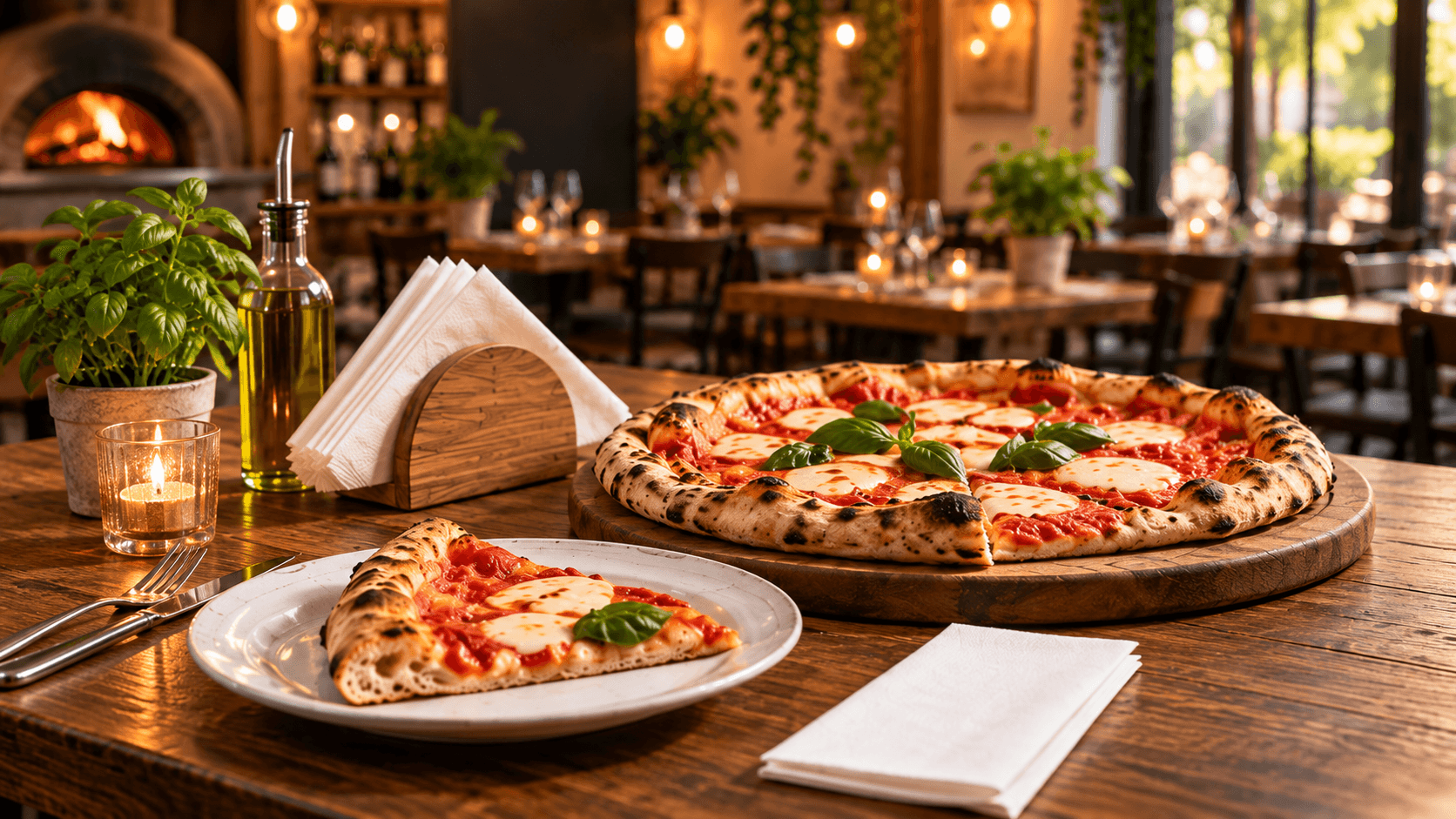
Pizza adds one complication to that list: it is eaten with the whole palm, so what counts is the total grammage the guest receives, not the number of plies in one sheet. How to work that out separately for the room and for delivery is in the guide to napkins for pizzerias.
Restaurant groups selling "experience"
Brunch concepts, fine casual, "Instagrammable" cuisine. Guests photograph the table. A thin, wrinkled napkin in the frame lowers perceived value in social proof. Lost word-of-mouth is intangible but real.
How ply shapes the guest experience
Customer experience in hospitality breaks into 5–7 micro-moments. The napkin enters three of them:
Micro-moment 1: the first 90 seconds at the table
The guest sits, picks up the menu, touches the cutlery, touches the napkin. Three sensory signals form a baseline rating before they order. Thick, textured materials raise expectations – the guest tolerates small service mishaps. Thin, stiff materials lower expectations and amplify every error.
Micro-moment 2: main course service
The waiter places the plate, the guest takes the napkin onto their lap. This is the moment where 2-ply feels "substantial meal." 1-ply is emotionally neutral – not harmful, but not building experience either.
Micro-moment 3: end of meal and the bill
The guest touches the napkin one last time, folds or sets it aside. The condition the napkin held through the meal shapes the final impression. 1-ply looks used after an hour. 2-ply still looks "fresh."
Operational implication: in venues with guest dwell time under 30 minutes (fast food, bars), the napkin only enters micro-moment 1. In venues with 60+ minutes at the table (casual+, fine dining) all three moments are active and 2-ply pays back in perceived quality.
How premium restaurants use table details
Four practices used by fine dining and premium hotels:
1. Napkin as brand identity
Custom embossing, a proprietary white, a seasonal pattern. Unit cost rises 15–30%, but the napkin becomes part of the brand story – the equivalent of Louboutin's red sole in fashion.
2. Coherence with interior design
Colour and texture matched to the room palette. Scandinavian-style venues use beige eco napkins. Industrial venues use dark grey. Classic venues use snow white. Details below the threshold of conscious attention, working in concert with everything else.
3. Seasonal rotation
Spring – pastels. Summer – earthy eco tones. Autumn – burgundy/olive. Winter – ivory/navy. Each rotation costs €0 extra (same plies, different colour) but signals "fresh venue" four times a year.
4. Subtle custom branding
Logo embossed without colour print. Visible only at a particular light angle. Guests spot it 30–60 minutes into the meal. Effect: "they think about details." Cost: 5–8% above unbranded.
How much a restaurant really saves with better napkins
A simulation across five venue types. Assumptions: 260 trading days, 2026 manufacturer prices, standard formats.
| Venue type | Guests/day | Cheap strategy | Optimal strategy | Annual saving |
|---|---|---|---|---|
| 60-seat bistro | 130 | 1-ply everywhere | Mixed 1/2-ply | +€140 |
| 90-seat casual | 200 | 2-ply everywhere | Mix with dispensers | +€400 |
| 80-seat bar/pub | 250 | 2-ply everywhere | 1-ply in dispensers | +€160 |
| Catering 1,000 covers/mo | – | 1-ply packed | 2-ply packed | −€120 (quality investment) |
| 60-room hotel | 80 (breakfast) | 1-ply | 2-ply 33×33 | −€200 (quality investment) |
The management takeaway: napkin savings aren't always a downgrade to 1-ply. In a high-margin venue, 2-ply is an investment in retention – cheaper than any other tool for building repeat visits. ROI of 2-ply in fine dining exceeds 8:1 on an annual basis when you account for Google reviews and return rate.
Guest psychology: napkin as a first quality signal
The napkin is one of three things a guest physically touches in the first 90 seconds at the table – alongside the menu and the cutlery. Hospitality CX research (Cornell School of Hotel Administration, 2019) shows that table-level details affect overall venue scores more strongly than interior design. A thin, low-absorbency napkin reads at the subconscious level as "the operator cut corners on me."
Concretely:
- In casual dining with an average ticket of €15–22, a 1-ply table napkin lowers "value for money" scores by 8–14%.
- In fine dining (ticket >€35), the same napkin becomes a deal-breaker – 23% of guests cite it as a noticeable standard drop.
- In a quick-service bar, 1-ply does not lower scores. Guests don't expect premium textiles next to a beer.
Premium guest behaviour
A guest spending €60+ won't tell the waiter "these napkins are cheap." They will remember it as part of the overall venue picture and:
- In 31% of cases, lower the tip by 1–2 percentage points.
- In 14% of cases, not return within six months.
- In 8% of cases, mention it in an online review.
Each of these mechanisms costs more than the per-piece saving on the napkin.
When 1-ply is the better call
1-ply is optimal in four scenarios:
- Dispensers at the bar and service counter. Guests pull 1–2 sheets, use them once, discard. Higher absorbency is wasted capacity. Saving: about 40% lower unit cost.
- Fast food and quick-service bars. Short dwell time (5–15 minutes), simple dishes, low table expectations. Annual saving for a bar serving 200 guests/day: €250–360 versus 2-ply.
- Food trucks and takeaway. The napkin is a hygiene function, not styling. 1-ply does the job.
- Back-of-house – kitchen, prep, surface cleaning. Only price per piece matters.
Institutional catering is a case of its own: the meal is eaten with cutlery, so one ply holds up on merit rather than on price alone. How to convert that into cost per meal served instead of price per thousand is in the guide to napkins for canteens.
When 2-ply pays back faster
2-ply is economically – not just visually – worth it in five situations:
- Casual dining with an average ticket above €12. Guests stay 40–70 minutes and reuse the napkin. 2-ply consumption is 50–60% lower than 1-ply, more than offsetting the higher unit price.
- Restaurants serving "messy" dishes – ribs, burgers, seafood. 1-ply tears on first use; guests grab 4–6 sheets. 2-ply works in 2–3.
- Venues that set the table. A napkin placed on the plate or in a ring must hold shape. 1-ply loses it in seconds.
- Catering and banquets. Guest eats standing, holding the plate, expecting stability. 2-ply doesn't tear under sauce.
- Hotels and breakfast buffets. A premium-standard table element with cost absorbed into the room rate.
Cost analysis: four real venues
Venue A – 60-seat bistro, average ticket €15, 130 guests/day
- 1-ply (33×33, 17 gsm) on table: 4 pieces/guest = 520/day = 135,200/year. Cost: €5.50/1,000 → €744/year.
- 2-ply (33×33, 36 gsm) on table: 2 pieces/guest = 260/day = 67,600/year. Cost: €9/1,000 → €608/year.
- Difference: €136 in favour of 2-ply.
Venue B – 80-seat poolside bar, average ticket €9, 250 guests/day
- 1-ply in dispenser: 2 pieces/guest = 500/day = 130,000/year. Cost: €5.50/1,000 → €715/year.
- 2-ply in dispenser: 1.5 pieces/guest = 375/day = 97,500/year. Cost: €9/1,000 → €878/year.
- Difference: €163 in favour of 1-ply.
Venue C – 50-seat fine dining, average ticket €50, 90 guests/day
- 2-ply standard 33×33: 2.2 pieces/guest = 198/day = 51,480/year. Cost: €9/1,000 → €463/year.
- 2-ply premium 40×40 with embossing: 1.8 pieces/guest = 162/day = 42,120/year. Cost: €17/1,000 → €716/year.
- Difference: −€253, a quality investment. ROI: a premium venue recoups this from the first 7 returning-guest visits over a year.
Venue D – event catering, 1,200 covers/month, average €15/person
- 1-ply folded: 5 pieces/guest = 6,000/month = 72,000/year. Cost: €5.50/1,000 → €396/year.
- 2-ply folded: 2.5 pieces/guest = 3,000/month = 36,000/year. Cost: €9/1,000 → €324/year.
- Difference: €72 in favour of 2-ply, plus materially better guest feedback (catering converts mostly on referrals).
Venue-type playbook
Fast food and quick-service bars
1-ply 33×33, in a dispenser, 1/8D fold (N1 system), available in the dispenser napkins category. Weight 17–19 gsm. Typical unit cost €5–6/1,000.
Coffee shop with light food
2-ply 24×24 on the table, with 1-ply in a counter dispenser. Weight 32–36 gsm. 1/4 fold. Unit cost €7–8/1,000.
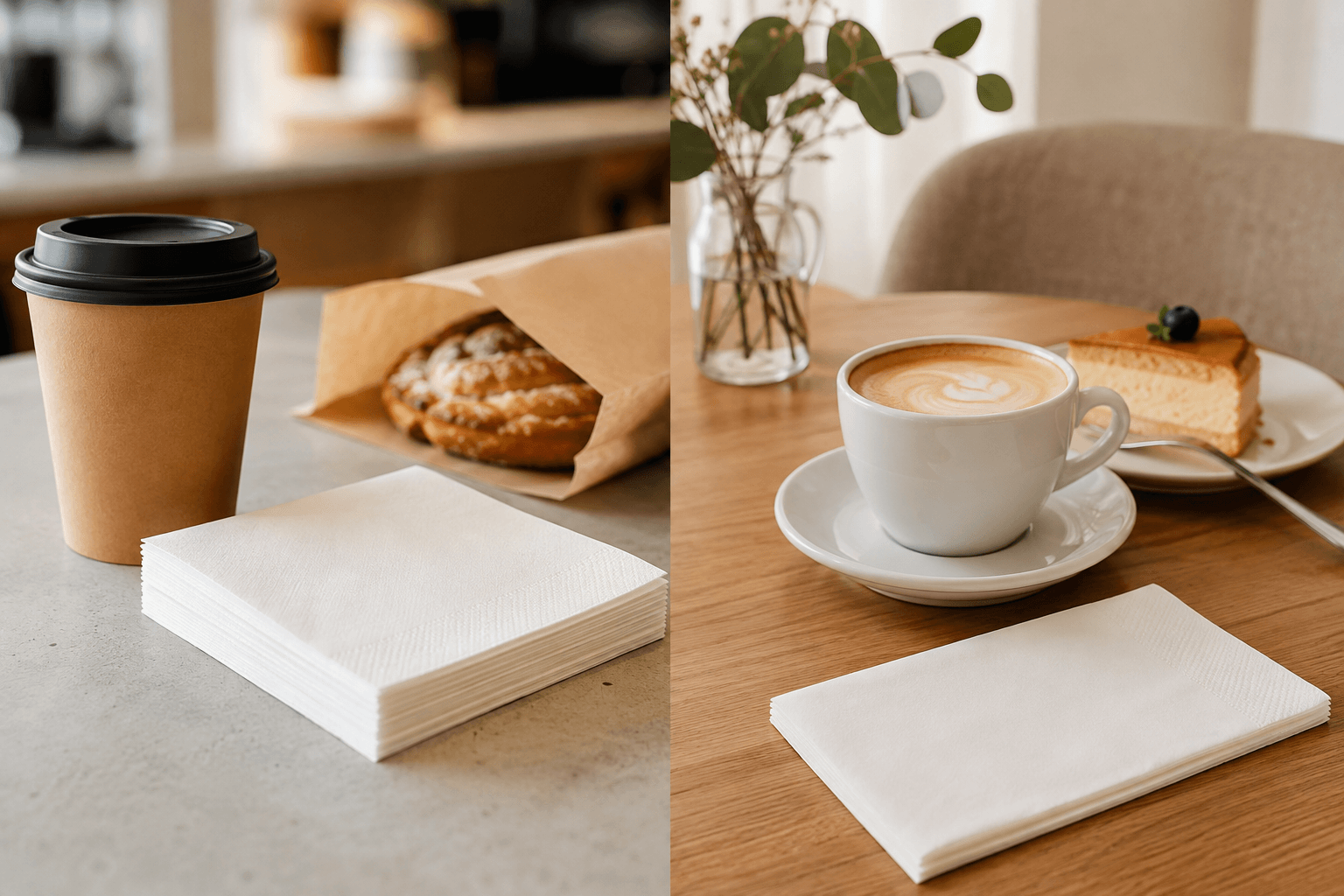
Under a cream cake and with fat-carrying pastry, plies behave differently than they do with sauce – we break that down in the guide to café and bakery napkins.
Casual dining
2-ply 33×33 on the table, 1-ply in the bar zone and at the till. Weight 34–38 gsm. 1/4 or decorative fold. Unit cost €8–10/1,000.
Premium / fine dining
2-ply 33×33 or 40×40 with embossing, weight ≥38 gsm. White, ecru or in brand colour. Decorative folds (rose, bishop's hat). Unit cost €13–20/1,000.
Catering
2-ply 33×33 or 40×40, folded for service (1/8 for upright dispensers). White or event colour. Branded for corporate events. Unit cost €9–13/1,000.
Hotels – breakfast buffet
2-ply 33×33 or 40×40. White or ecru. Weight 36–40 gsm. 1/4 fold for upright dispensers or decorative for à la carte. Unit cost €9–12/1,000.
Hotels – lobby bar and à la carte
2-ply 33×33 with logo embossing. Weight 38–42 gsm. Unit cost €14–18/1,000.
Food truck
1-ply 24×24 in a dispenser. Weight 16–18 gsm. 1/8 fold. Unit cost €4.50–5.50/1,000.
Back-of-house (kitchen, cleaning)
1-ply at the lowest weight available, 16 gsm. Fold is irrelevant; bulk packs of 5,000+. Cost €4–4.50/1,000.
Seasonality and peak periods
Napkin consumption is not flat. Three peak types:
Summer terraces
A venue with outdoor seating sees consumption rise 35–60% in June–August. Drivers: more drinks (more spills), more guests, longer dwell time. Plan: scale stock 25–35% upward in May; switch to quarterly orders.
Family events and holidays
First communions (May–June), weddings (June–September), Christmas (December). Catering and event venues see +80–120% in the peak week. Plan: reserve manufacturer capacity 6 weeks ahead, with a price held for the peak.
Weekend spikes
Most restaurants run +40–70% volume over weekends vs midweek. Most operators have no separate weekend stock plan, leading to Saturday-morning emergency runs. Plan: Monday delivery covers the whole week including weekend, with a 15% buffer.
Warehousing logistics
Restaurant storage is rarely designed around napkins. Four rules that cut losses from 5–10% to under 2%:
Humidity
Optimal 40–60%. Above 70% napkins curl and lose stiffness. Below 30% they crack on unfolding. A €7 hygrometer pays back in the first quarter.
Temperature
15–25°C. Storage behind a hot kitchen (often 30°C+) cuts shelf life by 30–40%. Keep napkins in the main store, not next to ovens.
Neighbours
Napkins absorb smell. Storage next to cleaning agents = chlorine-smelling napkins. Next to onions/spices = faint food smell. Keep in a separate room or at least 2 m from strong odour sources.
Light
UV fades colour. Coloured napkins on a shelf near a window lose saturation in 6–8 weeks. Keep in outer wrapping until use.
Waste and ESG implications
Hospitality generates 12–18% of municipal paper waste. Cutting napkin consumption 25–40% (through dispensers + matched ply) means:
- 50–80 kg less waste per year per 80-cover venue
- 10–15% lower waste collection cost (typically €140–200/year)
- real numbers for ESG reporting in chains tracking environmental impact
For groups with 20+ venues, this is a credible line in annual reports and investor materials.
Ten most common buying mistakes
- "Cheapest per piece" as the only criterion. Ignores consumption.
- One napkin type for the whole venue. Bar and table are different scenarios.
- Ignoring absorbency. A thin napkin with soup gets used in pairs.
- Costing per piece, not per cover. KPI should be "€ per ticket."
- Misalignment with positioning. Fine dining with 1-ply is an inconsistency.
- Ignoring seasonality. No buffer = emergency purchases +30–50%.
- No format standardisation. Three different sizes in one venue = warehouse chaos and dispenser misfeeds.
- Poor storage. 5–10% loss to humidity and odour.
- No annual price negotiation. Spot vs contract price is 8–18%.
- No consumption audit. A venue that doesn't know monthly usage can't optimise anything.
60-second decision framework
Three questions, three decisions:
- Where? Bar/dispenser → 1-ply. Table → 2-ply.
- Average ticket? Under €10 → 1-ply. €10–20 → mixed. Above €20 → 2-ply.
- "Messy" dish? Yes → 2-ply. No → 1-ply.
For most venues the optimal strategy is a combination of both across zones.
Buying checklist
Before the next order:
- Do I know monthly consumption (invoice × multiplier)?
- Do I have a split by zone (table, bar, kitchen)?
- Does each zone have the right ply and size?
- Have I calculated real cost per cover, not per piece?
- Does the weight match the venue's positioning?
- Does the order quantity hit a manufacturer's tier?
- Is there a 15–20% buffer for peaks?
- Is there a 12-month contract price in place?
- Is there a standing-order arrangement?
- Have I asked about prepayment and standing-order rebates?
Negotiating with a manufacturer: ten questions
Before signing with a supplier ask about:
- Price per 1,000 for my annual volume. Annual, not monthly – this opens negotiation 10–18% lower.
- Fixed contract price for 12 months. Hedge against pulp inflation (which swings 8–22% a year).
- Standing-order rebate. Recurring deliveries without reordering – usually another 4–8%.
- Prepayment rebate. Typically 2–4%, but ties up working capital.
- Lead time for standard and rush orders. Try to negotiate 24-hour emergency delivery in the package.
- Returns of out-of-spec batches. Complaint rate in napkins is typically 0.5–2%.
- Written technical spec. GSM, dimension, colour (Pantone), fold, outer packaging.
- Free samples before first order. Minimum 3 variants.
- Private label. Will the manufacturer produce under the customer's brand.
- References from my segment. At least three customers of similar size and category.
Red flags
- Manufacturer doesn't quote weight in g/m² (says "thicker" or "thinner").
- No volume discount table on the price list (no tiering = no scale).
- No FSC, ISEGA or EU 1935/2004 food-contact certification.
- Lead time "from 3 weeks" for standard formats (means no own production – you're at a reseller).
- No samples before order.
Key takeaways
- Ply is a cost-per-cover decision, not a price-per-1,000 decision.
- A thin napkin used twice costs more than a thick napkin used once.
- In a high-margin venue, 2-ply is an investment in retention, not an expense.
- The optimal strategy for 80% of restaurants is a mix: 1-ply in dispensers, 2-ply on the table.
- Cheaper napkins generate €700–1,800 of hidden cost a year in an average restaurant.
- Seasonality drives 35–120% spikes – the supply plan has to anticipate this.
- Storage drives 5–10% loss – controlled humidity and temperature pay back in the first quarter.
- A 12-month contract price is 8–18% cheaper than spot price.
What to do next
If you're verifying a supplier or consolidating purchases, the fastest route to real savings is comparing manufacturer prices for 1- and 2-ply across three standard sizes (24×24, 33×33, 40×40). See Napkins B2B terms – contract pricing, samples before first order, factory-direct delivery.
Related reading: How to cut single-use costs in hospitality, Complete HoReCa napkin guide, Manufacturer vs importer, Why restaurants overpay for napkins.