A restaurateur will spend weeks choosing furniture, tableware and a menu, then order napkins "the same as last time." Yet the napkin is one of the few things a guest holds through the entire meal — and quietly judges the place by. A thin, rough napkin can undercut the impression even after a great dish.
This guide walks through the seven trends shaping hospitality in 2026 and turns each into a concrete buying decision: size, ply, eco version, print or dispenser. We write as a paper-napkin manufacturer that advises restaurants, hotels and caterers day to day.
The figures here come from market observation and public trade reports. Treat them as a reference point, and always confirm final specs on samples.
Table of contents
- How is hospitality changing in 2026?
- Trend 1. Sustainability and certified materials
- Trend 2. Minimalism over excess
- Trend 3. Dark napkins return to premium dining
- Trend 4. Personalisation becomes the standard
- Trend 5. QR codes and guest communication
- Trend 6. A sharper focus on quality
- Trend 7. Dispensers control cost
- Should you adopt every trend?
- Trend comparison table
- Checklist for restaurant owners
- Key takeaways
How is hospitality changing in 2026?
Hospitality enters 2026 under three pressures that shape almost every purchasing decision: cost, guest expectations and sustainability.
Cost. Expensive energy, higher wages and volatile raw materials mean every budget line has to justify itself. Napkin prices move too, because pulp runs in price cycles. More venues now look past the unit price to real monthly usage.
Guest expectations. Guests expect consistency. A considered interior and a beautifully plated dish lose ground the moment a cheap, grey napkin hits the table. The napkin also lands in guests' photos next to the plate, so how it looks is part of the venue's image.
Sustainability. Pressure comes from guests and from regulation. Single-use plastic restrictions push attention toward paper — certified and biodegradable. A paper napkin fits that direction, as long as its origin can be documented.
From these three forces come seven concrete trends. We take them one by one, each with a clear buying conclusion.
> In short: In 2026 a napkin is a cost, a piece of the guest experience and a line in your waste bill all at once. Chosen well, it improves all three.
Trend 1. Sustainability and certified materials
Sustainability is no longer an add-on. In 2026 it is a real purchasing criterion, disposables included.
What it means for napkins
In practice a restaurant has two eco routes:
- FSC- or PEFC-certified pulp — paper from responsibly managed forests. It can be bright white, so there is no aesthetic compromise.
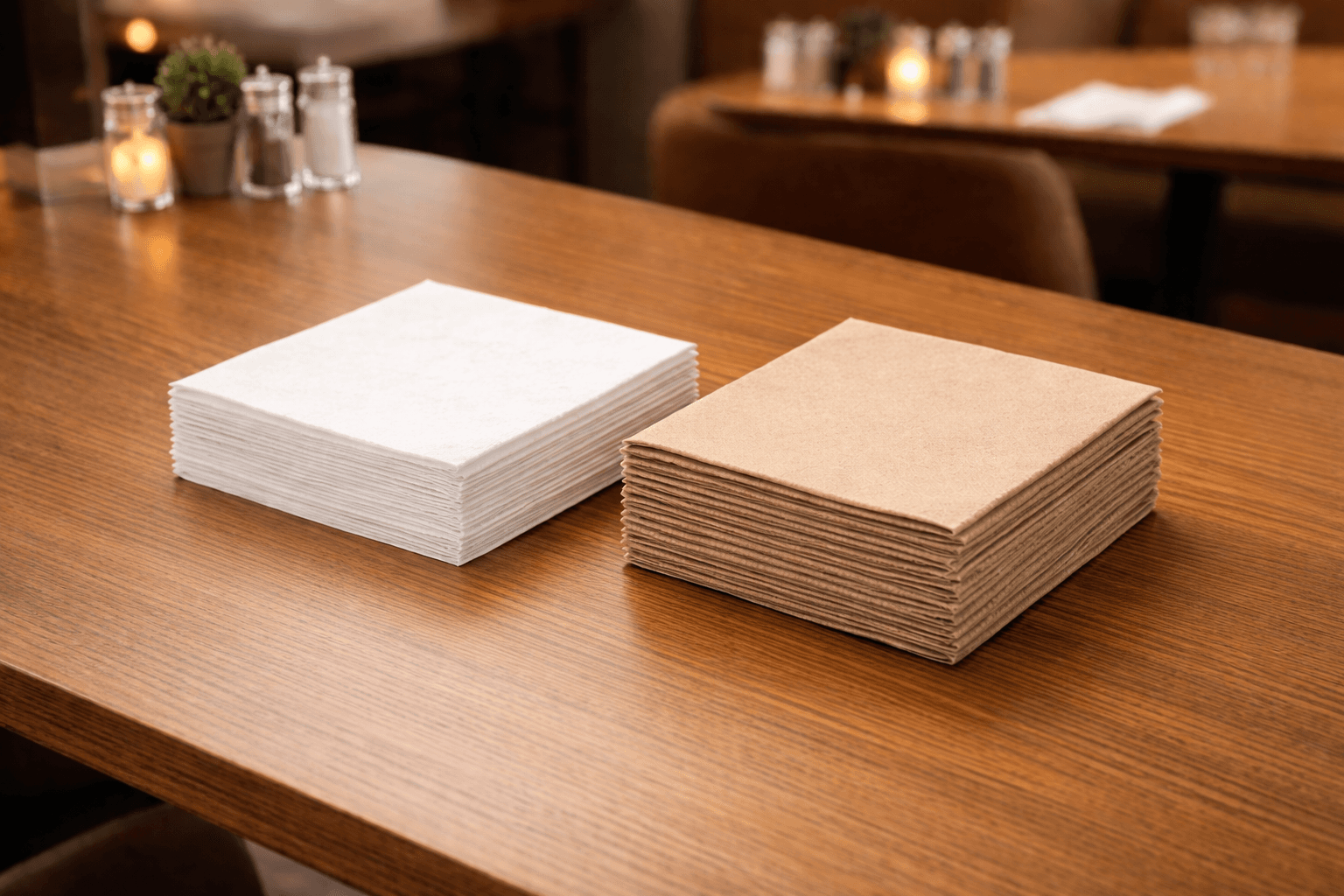
- Recycled paper — a lower footprint and a natural tone (greyish, beige). Recycled fibres are slightly shorter, so the napkin can be a touch less soft — in return it signals "eco" clearly.
Both are biodegradable. The choice comes down to whether you want crisp white (FSC) or a visible eco cue (recycled).
What to ask your supplier
Rather than trust adjectives, ask for two things: an FSC/PEFC certificate and a food-contact approval. The second is not a formality — the napkin touches lips and food, so it is a safety requirement. A serious manufacturer produces current documents without fuss.
The practical takeaway
An eco napkin usually costs 10–30% more. Don't roll it out "because everyone does" — put it where it fits the brand and the guest: an eco-certified hotel, a speciality café, a venue built on local produce. More in our comparison: are eco napkins worth it, and see the ready options in our eco napkin range.
> Definition: An eco napkin is made from certified pulp (FSC/PEFC) or recycled paper, is biodegradable, produced without chlorine bleaching, and cleared for food contact.
Trend 2. Minimalism over excess
The back half of the decade is a retreat from clutter. Venues are simplifying menus, interiors and tableware, and the napkin follows suit.
What minimalism looks like on the table
- Simple design — a discreet logo in the corner instead of a print across the whole surface.
- Classic colours — white, ecru, grey, deep black. No gradients, no loud graphics.
- Quality over flash — the premium impression comes from grammage and a clean fold, not the number of colours.
- Function — a size matched to the dish, a readable fold, nothing for show.
Why it pays off
Minimalism is often cheaper than it looks. A one-colour print costs less than full colour, and on a napkin with good grammage it looks elegant. Keeping to one or two designs also simplifies ordering and storage: fewer variants mean fewer mistakes and cleaner logistics.
> In short: In 2026 a simple, well-made napkin reads better than an overloaded print. One clear detail beats five average ones.
Trend 3. Dark napkins return to premium dining
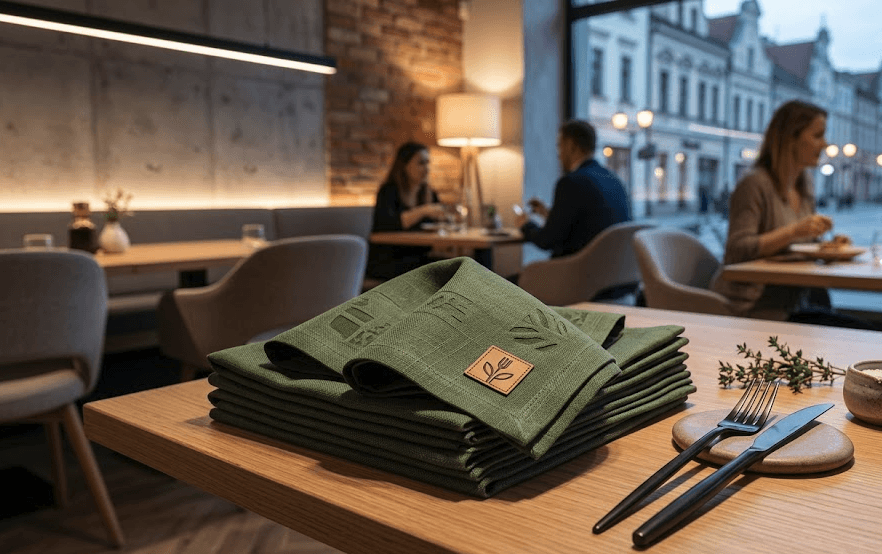
Black, charcoal and navy napkins are back in the premium segment and in venues with a modern, raw look. This is a deliberate styling choice, not a default for everyone.
Why dark
- Black — strong contrast on a light table, hides wine and sauce stains.
- Charcoal — softer, at home in industrial and concrete interiors.
- Navy — warm and elegant, works well with wood and brass.
When they fit
- Fine dining and bistronomy
- Cocktail bars and evening venues
- Industrial, dark-academia and japandi interiors
- Themed events and tasting dinners
When white is the better call
- Hotel breakfasts and buffets — white reads as clean
- Classic family dining
- Daytime venues with natural light
- Anywhere a neutral, hygienic look matters
For most venues, white napkins remain the safest and most versatile choice. Treat dark as a considered accent where it fits the interior and the time of service.
The practical takeaway
If you go dark, order a sample first and check two things: how the colour looks under your own evening lighting, and whether the paper marks the hands. If you plan a QR code on a dark napkin, it needs a light patch beneath it — a dark code on a dark ground won't scan on a phone.
> Definition: A dark premium napkin is usually a 2- or 3-ply paper in black, charcoal or navy, chosen to match the look of evening service.
Trend 4. Personalisation becomes the standard
What set a venue apart a few years ago is now the norm. A logo napkin is a basic, low-cost branding tool in hospitality.
What personalisation covers
- Logo — the simplest print, seen by the guest at every meal.
- Brand colours and tagline — the napkin in step with the menu and interior.
- Seasonal editions — holiday motifs, event runs, collaborations.
- Recognition and guest experience — repeated brand contact and a signal of attention to detail.
The numbers
A venue serving 200 guests a day, at 2–3 napkins each, generates 400–600 brand impressions daily — tens of thousands a month. The cost per impression is a fraction of a penny, and it lands during a real, positive moment with the venue.
How to order printed napkins
- Method: the standard is flexography — printing in 1–4 colours with water-based, food-contact-approved inks. For short runs, digital print works well.
- File: supply the logo as a vector for a sharp print at any scale.
- Design for the fold: a logo centred on the open napkin can disappear into a crease. Design for what shows once folded.
- Cost and time: print adds about 10–25% to the price; production runs 7–14 working days plus artwork.
More in our piece on personalised napkins and in our logo napkin range.
> In short: A plain napkin is advertising space you already pay for and leave blank.
Trend 5. QR codes and guest communication
The QR code has moved off the table stand and onto the napkin — where it works better, because the guest picks the napkin up while the stand gets overlooked.
Where to point the code
- Online menu — always current, with no reprint cost.
- Google reviews — the ask lands while the guest is happy.
- Loyalty programme — sign-up with no physical card.
- Social media — Instagram, TikTok, the venue profile.
- Promotions — a seasonal offer, a themed night, a discount on the next visit.
How to do it well
- Give it a legible size (at least about 2 cm) and a light margin around the code.
- Ensure contrast — a dark code on a light ground; on a dark napkin add a white patch.
- Add a short call to action ("Scan to see the menu"); a bare code gets ignored.
- Point it at a page that reads well on a phone. If you collect data (e.g. for loyalty), handle consent as required.
Use a dynamic code — it lets you change the destination without reprinting, and count scans so you know what works.
The practical takeaway
If you already order printed napkins, adding a QR code adds no production cost — it is part of the artwork. It only makes sense if you have somewhere to send the traffic: a current online menu or a tended Google profile. Details in our guide: QR codes on napkins.
> Definition: A dynamic napkin QR code routes through a redirect link whose destination can be changed at any time without replacing the napkins.
Trend 6. A sharper focus on quality
Guests increasingly link napkin quality with venue quality. A thin, rough napkin undercuts the whole meal — even when the food is excellent.
Comparing plies
| Parameter | 1-ply | 2-ply | 3-ply |
|---|---|---|---|
| Typical grammage | 16–19 g/m² | 32–38 g/m² | 48–57 g/m² |
| Absorbency | basic | good | very good |
| Wet strength | low | medium | high |
| Feel | rough | soft | soft, "premium" |
| Segment | fast food, dispensers | casual, cafés | fine dining, banquets |
Heavier paper is not just a nicer feel — it is a napkin that actually mops up a spilled drink instead of falling apart on first use. Over a month, the gap between 1-ply and 2-ply is often less than one dinner for two, and it noticeably lifts guest comfort.
Size is quality too
A napkin that is too small for the dish spoils the impression as much as thin paper. Matching format to the way food is served is the simplest route to comfort and less waste:
- 15×15 cm — drinks, coffee, cocktails
- 24×24 cm — bars, fast food, catering, events
- 24×33 cm — hotel breakfasts and buffets
- 33×33 cm — restaurants, catering, banquets (available in 1–3 plies)
- 33×21 cm — bistros, lunch service, canteens
How to check a sample
No lab needed — a few seconds on a sample will tell you:
- Lay it on spilled water — a good napkin soaks it up in 2–3 seconds.
- Wipe a wet surface — check it doesn't tear or shed lint.
- Press it to the skin — the guest will do the same.
If you are torn between plies, our comparison settles it: 1-ply vs 2-ply napkins.
> In short: In 2026 napkin quality is no longer invisible. Guests feel it in the hand — and in whether it copes with a spill.
Trend 7. Dispensers control cost
Under cost pressure, the dispenser returns as a simple tool for controlling usage. It is a purely practical trend — which is exactly why it is growing.
What dispensers deliver
- Saving — one napkin at a time curbs the grab-a-handful reflex. Dispenser makers report usage cuts of around 25–40%.
- Hygiene — guests touch only their own napkin, not the whole stack.
- Order — a tidy station instead of a scattered holder.
Where they fit best
- Self-service restaurants and food courts
- Fast food and quick-service bars
- Service stations with food offerings
- High-flow breakfast areas and buffets
What to watch
A dispenser napkin has its own 1/8D fold in the N1 system: the final panel sits shifted by a narrow strip (the offset) that gives fingers a grip on one sheet. Nothing advances by itself, so placement and replacement timing decide the outcome.
Matching formats are in our dispenser napkin range.
> Definition: A dispenser napkin is a fold designed for an automatic unit, usually 1-ply, released one at a time for hygiene and usage control.
Should you adopt every trend?
No. No venue needs all seven at once. The choice should depend on four things.
- Type of venue — fine dining, casual, fast food and hotels have different priorities.
- Budget — not every trend returns in every model.
- Guest base — younger guests value eco and QR codes; business diners value quality and a discreet print.
- Brand style — the napkin should reinforce the brand, not compete with it.
Matching trends to venue type
| Venue type | Highest-priority trends |
|---|---|
| Fine dining | quality (Trend 6), dark napkins (Trend 3), personalisation (Trend 4) |
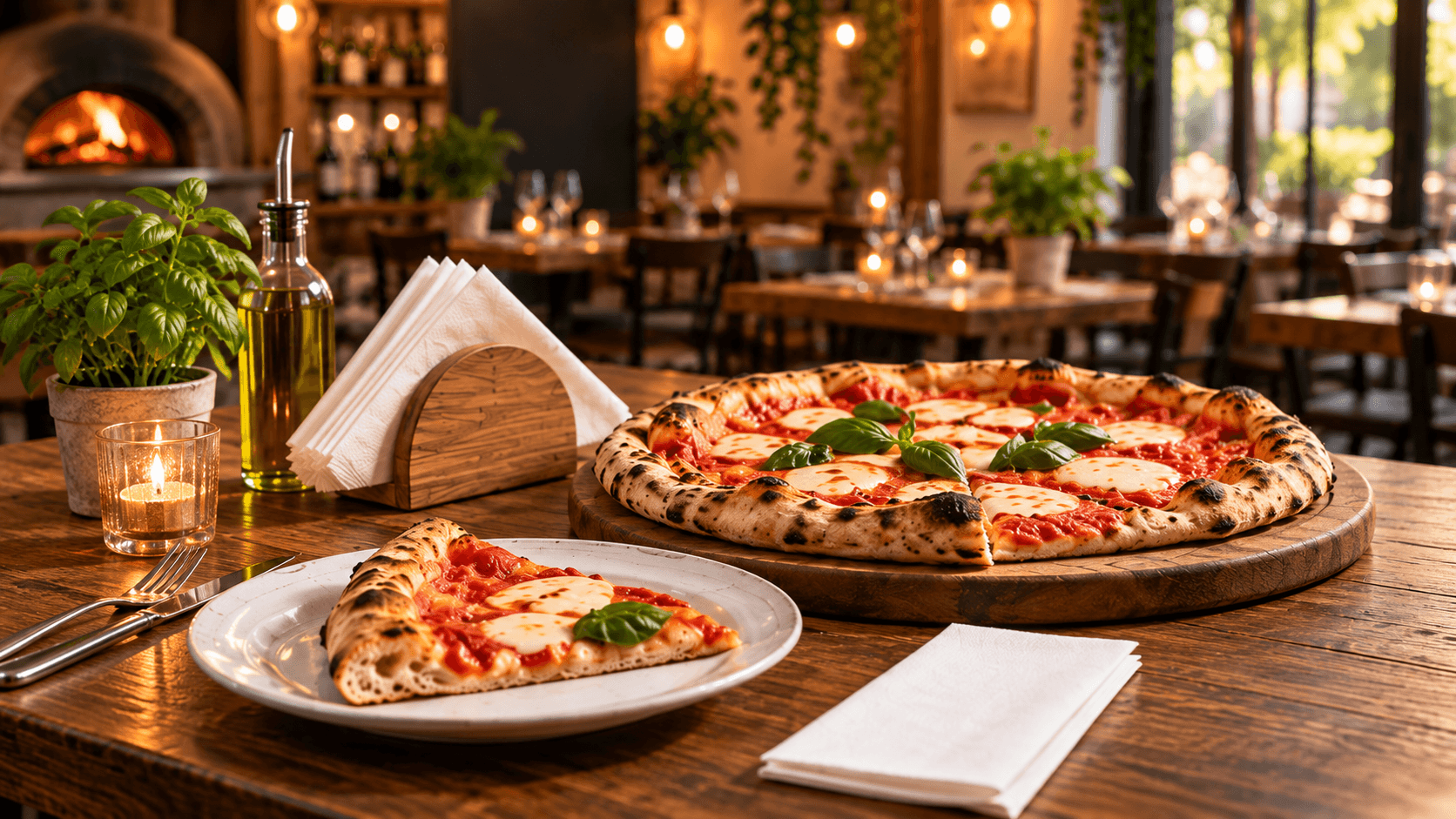
| Casual dining / pizzeria | personalisation (Trend 4), quality (Trend 6), QR codes (Trend 5) |
| Café / speciality | eco (Trend 1), minimalism (Trend 2), QR codes (Trend 5) |
| Fast food | dispensers (Trend 7), recycled eco (Trend 1) |
| Hotel | quality (Trend 6), eco (Trend 1), personalisation (Trend 4) |
| Catering / events | personalisation (Trend 4), quality (Trend 6), eco (Trend 1) |
A quick test before you commit
Before adopting a trend, ask three questions: Does it fit my guest? Will it return in my model? Does it reinforce my brand? If any answer is "no", the trend is a cost, not an investment. Start with one or two well-fitted trends rather than all of them at once.
> In short: A trend adopted without fitting it to the venue is a cost, not an investment.
Trend comparison table
| Trend | Core benefit | Who it suits | Cost impact |
|---|---|---|---|
| Sustainability | image, meeting guest expectations | hotels, cafés, eco-led venues | +10–30% |
| Minimalism | elegance and simpler ordering | every segment | neutral or lower |
| Dark napkins | styling, stain masking | premium, cocktail bars | +5–20% |
| Personalisation | branding, recognition | venues with steady volume | +10–25% |
| QR codes | communication, reviews, loyalty | venues with an online presence | no production cost |
| Quality | comfort, better perception | casual, premium, hotels | +40–70% per ply |
| Dispensers | saving, hygiene | self-service, high traffic | cuts usage 25–40% |
Checklist for restaurant owners
Before your next napkin order in 2026, run through this list:
- [ ] Do I know my venue's profile and what it should prioritise?
- [ ] Does the napkin size suit the dish and the way it is served?
- [ ] Does the ply match what my guests expect?
- [ ] Have I considered an eco version where it matters to the customer?
- [ ] Do I have an FSC/PEFC certificate and food-contact approval from the supplier?
- [ ] Is the print on-brand and legible once the napkin is folded?
- [ ] Does the napkin colour suit the interior and the time of service?
- [ ] Do I have somewhere to send QR traffic (menu, Google, social)?
- [ ] In self-service areas, am I using dispensers with a matching format?
- [ ] Am I ordering samples and checking quality before a large run?
Key takeaways
- 2026 hospitality rests on three forces: cost, guest expectations and sustainability. The napkin sits where they cross.
- Don't adopt every trend at once. Pick the ones that fit the venue, budget and guest.
- Eco works when it fits the brand — and when you have the paperwork. A certificate beats the word "eco".
- Size and quality are the basics. The right format and a heavier ply are the cheapest guest-comfort upgrade in the whole venue.
- Personalisation and QR codes turn a napkin into cheap marketing — provided the design and destination are right.
- Dispensers are the simplest cost lever in a high-traffic venue.
- A manufacturer gives you flexibility — size, grammage, eco version and print matched to your venue, plus samples before a large order. Start with a conversation with us, or see the B2B wholesale offer.
> Want to match your napkins to the 2026 trends? We'll help you choose the size, grammage, eco version and print for your venue's profile. Free samples and prices direct from the manufacturer — get in touch.