The Calculation Nobody Does — Until They See the Number
A mid-size casual dining restaurant: 100 covers, 180 guests daily, 3 napkins per guest, 280 operating days per year. That's 151,200 napkins annually.
The price difference between direct manufacturer pricing (€8.50/1,000) and a typical foodservice distributor (€16/1,000) is €1,134 per year. For the same product. With the same delivery schedule. The only thing that changes is who you call to order.
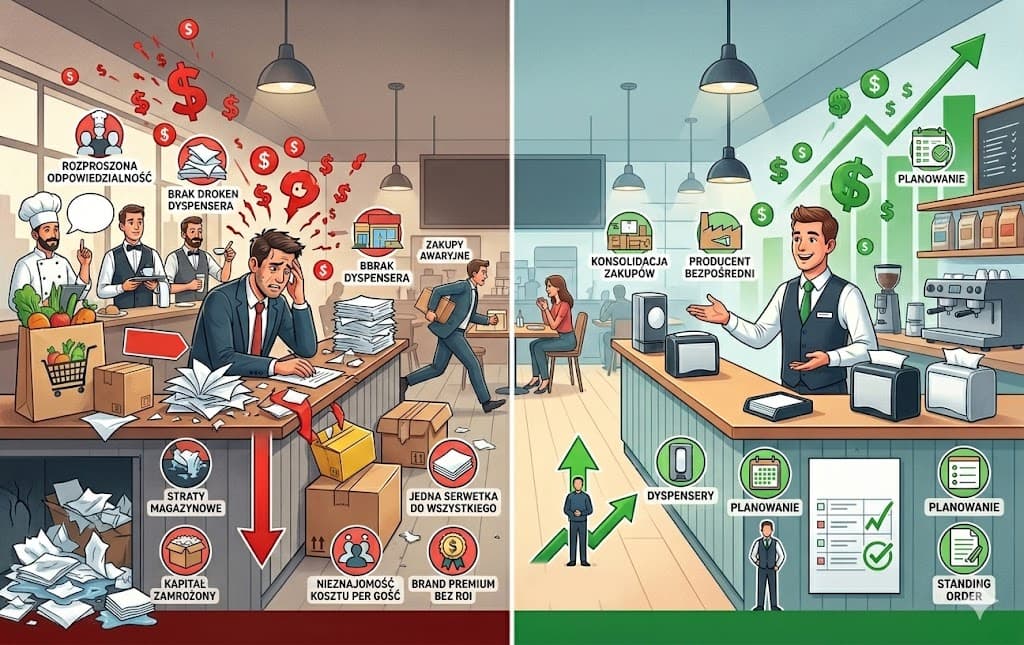
Now add: no dispenser (+35% consumption = 52,920 extra napkins = €450), two emergency purchases monthly (€480/year), no annual negotiation (missing 14% discount = €880), storage losses 5% (€300). Total avoidable overpayment: €3,244/year in a restaurant that thinks it's buying smart.
This article is a procurement audit. Not theory — specific cost data, European HoReCa benchmarks, and a five-step fix you can begin this week.
5 Root Causes of Napkin Overspending in Hospitality
1. No Procurement Ownership — The "Nobody's Problem" Trap
In most independent restaurants, napkins are nobody's category. The kitchen manager orders paper towels, the floor supervisor decides on table napkins, the cleaning staff handles bathroom supplies. Three people, three sources, zero coordination, zero volume consolidation.
This isn't about individual incompetence — it's a structural problem that's almost universal in the sector. The combined budget for all paper products in a restaurant typically runs €400–€900/month. Significant enough to optimise, small enough that nobody takes ownership.
Financial consequence: purchasing through 3–4 separate channels increases average unit cost by 28–45% compared to consolidated direct ordering. A 100-cover restaurant loses €1,400–€2,200/year purely from fragmented procurement.
Real example: A gastropub in Birmingham was ordering table napkins from a catering platform, kitchen roll from a cash-and-carry, and bathroom tissues from a local wholesaler. Consolidating all three to one direct supplier reduced the blended unit cost by 34%. Annual saving: €1,650 — with no change in delivery frequency or product spec.
The fix: assign one person, one supplier, one invoice, one annual negotiation. It takes one afternoon to set up and pays back for years.
2. The Distributor Habit — Convenience Priced at a Premium
European hospitality procurement has a structural inefficiency: most operators buy through a distribution layer that adds 40–80% to the ex-manufacturer price, because calling a manufacturer directly feels like too much work. It isn't.
2026 European HoReCa napkin pricing by channel (2W cellulose, 33×33cm):
| Channel | Price per 1,000 units |
|---|---|
| Direct manufacturer, annual contract | €7.50–€10.00 |
| Direct manufacturer, spot order | €9.00–€12.50 |
| Foodservice distributor | €13.00–€18.00 |
| Catering platform / online | €14.50–€21.00 |
| Cash & carry | €12.00–€17.00 |
| Retail | €18.00–€28.00 |
The spread between the first and last row: 150–280% on an identical product. For a restaurant using 100,000 napkins/year, that's a gap of €1,050–€1,800 between best and worst procurement decision.
Real example: A restaurant group with 3 locations in the Netherlands was sourcing napkins through a national foodservice platform at €17.50/1,000. A single RFQ sent to three manufacturers resulted in a direct contract at €9.20/1,000 covering all three sites. Annual saving across the group: €2,470 — for two hours of procurement work.
3. One Product for Every Use Case — A False Economy
"We use the same napkin everywhere" sounds efficient. It isn't. Using an expensive airlaid napkin at the bar, or a flimsy 1-ply at the fine dining table, both cost money in different directions.
Product-to-application matching (2026 pricing):
| Application | Optimal product | Cost range |
|---|---|---|
| Bar / counter / takeaway | 1-ply cellulose in dispenser | €4.50–€6.50/1,000 |
| Casual dining table | 2-ply cellulose 33×33 | €7.50–€11.00/1,000 |
| Premium casual | 2-ply cellulose premium or thin airlaid | €11–€16/1,000 |
| Fine dining | Airlaid or fabric-feel | €18–€30/1,000 |
| Catering / events | 2-ply 40×40 | €12–€18/1,000 |
Real example: A 100-seat brasserie in Lyon was using airlaid 33×40 (€22/1,000) at every table — fine dining quality for a mid-range bistro format. The switch to 2-ply premium cellulose (€10.50/1,000) at a volume of 5,000 units/month generated an annual saving of €3,420 with zero complaints from guests. On the other side: a Michelin-starred restaurant in Dublin using standard 2-ply had guests noticing the disconnect with the rest of the experience. Upgrading to airlaid added €1,100/year — but protected the brand perception that drives €180 average covers.
4. The Missing KPI: Cost per Cover
Without this metric, every purchasing decision is intuitive. With it, every change — new product, new supplier, new dispensing system — shows up in one number.
How to calculate: monthly napkin spend (€) ÷ monthly covers = cost per cover.
2026 European casual dining benchmarks:
| Format | Target range | Needs attention | Problem |
|---|---|---|---|
| Fast casual with dispenser | €0.003–0.007 | €0.008–0.012 | >€0.013 |
| Casual dining no dispenser | €0.009–0.015 | €0.016–0.022 | >€0.023 |
| Fine dining | €0.018–0.035 | €0.036–0.050 | >€0.051 |
Why this matters more than monthly spend: a restaurant spending €320/month with 3,200 covers costs €0.10/cover — identical to spending €640/month with 6,400 covers. But if your volume grows and your spend doesn't scale proportionally, your procurement is working. If spend grows faster than covers — you have a problem.
Real example: A hotel restaurant in Vienna measured napkin cost per cover for the first time at €0.038. After installing dispensers and renegotiating with a direct supplier: €0.019/cover. With 110,000 annual covers, that's an annual saving of €2,090 from two changes that took less than a month to implement.
5. No Annual Supplier Review — Loyalty Without Leverage
The napkin manufacturing market changes every year: new capacity, raw material price shifts, new entrants. A restaurant that never asks gets the price for "passive customers" — which is always higher than the price for "active procurement."
The loyalty premium in hospitality procurement — the price penalty paid by operators who never renegotiate — typically runs 15–25% above the best available market price. On a €5,000/year napkin budget, that's €750–€1,250 per year for doing nothing.
Real example: A restaurant group with 5 casual dining venues in Belgium had used the same distributor for 4 years. First RFQ sent to direct manufacturers: the lowest offer was 26% below the current price. Contract signed for all 5 locations. Annual saving across the group: €5,720 for a process that took 3 hours of procurement work.
15 Hidden Cost Drivers — A Full Operational Audit
1. Retail purchasing as the default channel
Business problem: retail pricing reflects consumer convenience markup, not B2B volumes. There's no logical reason for a commercial operation to buy supplies at retail unless no other option exists.
Financial consequence: retail vs. direct manufacturer on 100,000 napkins/year = €850–€1,900 annual overpayment.
Example: A café chain buying retail at €22/1,000 switched to direct at €9.50/1,000. Annual saving across 4 locations: €2,460.
2. Mismatched product quality (both over-spec and under-spec)
Business problem: guest perception of napkin quality correlates with weight (gsm), whiteness, and feel — not brand name. Matching product spec to the dining experience is the key discipline.
Financial consequence: airlaid at a counter operation = 2–4× overspend. Single-ply at a fine dining cover = brand damage worth multiples of the "saving."
Example: Casual restaurant switching from airlaid (€22/1,000) to 2-ply premium cellulose (€11/1,000) at 4,000/month: €2,640 annual saving.
3. Open-access napkin basket — behavioural economics costing money
Business problem: open access creates habitual consumption, not need-based consumption. Guests take napkins because they're there, not because they need them.
Financial consequence: basket/open access → 2.8–4.2 napkins per cover. Dispenser → 1.1–1.5 per cover. At 200 covers/day, 300 days, €0.009/napkin: €1,458–€2,268 annual difference per location.
Example: A 4-pub group moved napkins from table baskets to dispensers at the pickup points. Average consumption reduction: 34%. Annual saving across 4 locations: €6,120 — from the change in how napkins were handed out. Three conditions keep that effect in place: the unit stands at the pickup point, it is not overfilled, and it is replaced at about one third of its load.
4. Emergency purchasing — 60–130% premium for poor planning
Business problem: no safety stock + reactive ordering = last-minute retail purchases at 2× the contracted price. Two emergency purchases per month at a 70% premium costs more than the price of systematic stock management.
Financial consequence: 3 emergency purchases/month at 1,500 units each, 70% premium = €1,890–€2,700/year in crisis logistics.
Example: Seasonal restaurant implemented a 3-week safety stock + monthly standing order. Emergency purchases: zero. Annual saving: €1,620 plus elimination of weekend supply crises.
5. No annual RFQ (Request for Quotation)
Business problem: manufacturers have "passive customer" pricing and "active procurement" pricing. The gap is consistent and exploitable.
Financial consequence: missing the annual renegotiation = €600–€1,400/year at typical restaurant budgets.
Example: Restaurant owner sent RFQs to 3 manufacturers after 3 years with the same distributor. Best offer: 28% below current pricing. Annual saving: €1,120.
6. Excess inventory — capital lock-up and humidity damage
Business problem: paper cellulose absorbs moisture above 60–65% RH. Restaurant storerooms near dishwashers, below ground, or adjacent to kitchens frequently exceed this threshold. A 3-month stock buffer exposes napkins to conditions that cause clumping, yellowing, and waste.
Financial consequence: damaged stock losses of 5–12% annually on a €5,000/year budget = €250–€600 annual waste.
Example: Restaurant moved napkin storage from a basement storeroom (72% RH) to a ground-floor pantry (48% RH). Losses dropped from 9% to 0.8%. Annual saving: €410 with zero investment.
7. Non-consolidated SKU portfolio
Business problem: 4 different napkin types from 4 different suppliers means no volume leverage on any individual SKU. Volume discounts require volume commitment — which requires consolidation.
Financial consequence: consolidating from 4 SKUs/3 suppliers to 2 SKUs/1 supplier typically unlocks 12–20% volume discount. On a €6,000/year total budget: €720–€1,200 annual saving.
Example: Pizzeria group consolidated 3 napkin SKUs to one supplier. Volume discount negotiated: 17%. Annual saving: €1,020.
8. The abundance effect — behavioural waste at scale
Business problem: volume availability triggers volume consumption. This is not a guest behaviour problem — it's a service design problem. The basket isn't "generous" — it's an uncontrolled variable costing you money.
Financial consequence: quantified at 1.5–2.5 extra napkins/cover in open-access vs. dispenser settings. At restaurant scale: €800–€2,500/year per location from this single variable alone.
Example: A chain of 6 fast casual restaurants switched to single-sheet serving at the pickup point. Average per-cover reduction: 1.8 napkins. Annual saving per location: €1,140. Group total: €6,840/year.
9. No cost-per-cover measurement
Business problem: without measurement, optimisation is impossible. You cannot know whether a more expensive product with lower consumption is more economical than a cheaper product with higher consumption.
Financial consequence: restaurants measuring cost-per-cover consistently outperform those that don't by 20–35% on napkin efficiency. That's not coincidence — it's the effect of having one number to optimise.
Example: Hotel F&B director tracked cost-per-cover monthly for 6 months, then made two changes. Result: from €0.042 to €0.021/cover. Annual saving at 75,000 covers: €1,575.
10. Small pack sizes — retail convenience at B2B scale
Business problem: packs of 100–200 napkins cost 40–80% more per unit than bulk cartons of 5,000–10,000. Buying small because "we don't want stock sitting around" finances convenience at the expense of margin.
Financial consequence: moving from 200-unit packs (€0.085/napkin) to 5,000-unit cartons (€0.042/napkin) at 3,500/month consumption: €1,806/year saving with a 3-week storage commitment.
Example: Café using individual packs switched to carton buying. Annual saving at 2,400/month consumption: €1,238.
11. No B2B negotiation — leaving money on the table
Business problem: manufacturer list prices assume no relationship, no volume commitment, no multi-year history. Each of these three factors commands a 5–8% discount independently. Together: 12–22%.
Financial consequence: on a €4,500/year budget, no negotiation = €540–€990/year forfeited in available discount.
Example: Procurement manager called manufacturer with a 12-month volume declaration. Received 19% discount from list. Annual saving: €855 for one 45-minute conversation.
12. Brand premium without measurable ROI
Business problem: premium branded napkins (Duni, Tork, Hoffmaster) carry a 30–90% price premium over technically equivalent private label. Guest perception research consistently shows napkin quality is judged by weight, whiteness, and texture — not the brand printed on the packaging they never see.
Financial consequence: premium brand vs. equivalent private label at identical spec: 30–90% overpayment with no measurable improvement in guest satisfaction or review scores.
Example: Airport restaurant switched from Duni premium (€21/1,000) to equivalent private label (€11.50/1,000) at 6,000/month. Annual saving: €6,840. Guest satisfaction scores: unchanged.
13. Product-format mismatch creating operational friction
Business problem: napkin size, fold, and dispenser compatibility need to match the service format. The wrong size in the dispenser jams it. The wrong fold blocks smooth dispensing. Operational friction = floor staff workarounds = more consumption.
Financial consequence: dispensers that jam due to product mismatch are bypassed by staff, returning to open-basket service. Full dispenser benefit is lost. Engineering the right product-dispenser match is a one-time 30-minute task.
Example: Restaurant installed dispensers but kept purchasing folded napkins incompatible with the dispenser format. Staff left baskets on tables instead. After switching to compatible product: 31% consumption reduction achieved as intended.
14. Storage losses — FIFO, humidity, mechanical damage
Business problem: cellulose napkins stored incorrectly (high humidity, LIFO rotation, floor-level damp, near heat sources) degrade measurably. The loss is invisible until you count unusable units at inventory.
Financial consequence: 5–12% annual loss on a €5,000 budget = €250–€600/year in direct waste.
Example: 3 simple rules — palletised storage (not floor), FIFO via date-stamping, maximum 6-week stock. Losses from 8% to 0.9%. Annual saving: €355 at zero cost.
15. Manual ordering — time cost and missed standing order discounts
Business problem: weekly manual napkin ordering takes 15–25 minutes of manager time. Annually: 13–22 hours. At €30/hour labour cost: €390–€660/year in administrative overhead for ordering napkins. Standing orders eliminate this entirely and typically carry a 3–6% discount for volume predictability.
Financial consequence: switching to monthly standing order with a 4-week delivery cycle: saves €390–€660 in management time + 3–6% discount (€135–€270 on a €4,500 budget). Total: €525–€930/year for zero operational change.
Example: Multi-site operator set up standing orders across 6 venues. Annual saving: 52 hours of manager time (€1,560) + 4.5% volume discount (€1,080) + elimination of 3 emergency purchases/site (€2,160). Total: €4,800/year.
The Annual Loss Calculator: How Much Is Your Restaurant Leaving Behind?
Small independent restaurant (40–60 covers, ~120 guests/day, budget €1,500–€2,200/year)
| Issue | Annual loss |
|---|---|
| Retail/distributor channel vs. direct | €400–€700 |
| No dispenser | €250–€420 |
| Emergency purchasing | €200–€380 |
| No annual renegotiation | €150–€330 |
| Storage losses (6%) | €90–€132 |
| Total | €1,090–€1,962 |
For a restaurant spending €1,800/year, these fixable errors represent 60–109% of the current spend.
Mid-size restaurant (80–120 covers, ~250 guests/day, budget €3,500–€5,500/year)
| Issue | Annual loss |
|---|---|
| Wrong sourcing channel | €900–€1,800 |
| No dispensers | €750–€1,350 |
| No volume consolidation | €420–€770 |
| No annual negotiation | €420–€825 |
| Product mismatch | €350–€650 |
| Total | €2,840–€5,395 |
Restaurant group (5 locations, ~800 guests/day total, budget €15,000–€25,000/year)
| Issue | Annual loss |
|---|---|
| No central procurement | €3,750–€6,250 |
| No group contract | €2,250–€4,500 |
| Dispenser gaps across 3 sites | €2,100–€3,600 |
| No standing orders | €1,500–€2,500 |
| Storage losses across sites | €750–€1,250 |
| Total | €10,350–€18,100 |
Scale effect: a 1 cent difference per napkin at 1,000,000 napkins/year across a group = €10,000/year from a single line in a contract.
A 5-Step Fix, Ordered by ROI
Step 1 (this week): Calculate your napkin cost per cover. Divide last month's napkin spend by last month's covers. Compare to the segment benchmarks above. This is your baseline.
Step 2 (this month): Request a direct quote from a manufacturer. Use your actual monthly volume as your opening declaration. Ask specifically for the 12-month contract price and standing order discount. See our wholesale offer for reference pricing.
Step 3 (this month): Install dispensers at your 3 highest-consumption zones. Measure consumption before and after over 4 weeks. The result will appear in your next invoice.
Step 4 (this quarter): Consolidate to 2 product standards (bar/counter + table) from one supplier. Simplify the SKU portfolio, improve volume leverage, eliminate cross-supplier management overhead.
Step 5 (this quarter): Set up a monthly standing order with a 3-week safety buffer. Eliminate emergency purchasing permanently. Lock in the standing-order volume discount.
For more context, read our complete guide to restaurant paper supply management and the full hospitality consumables cost analysis.