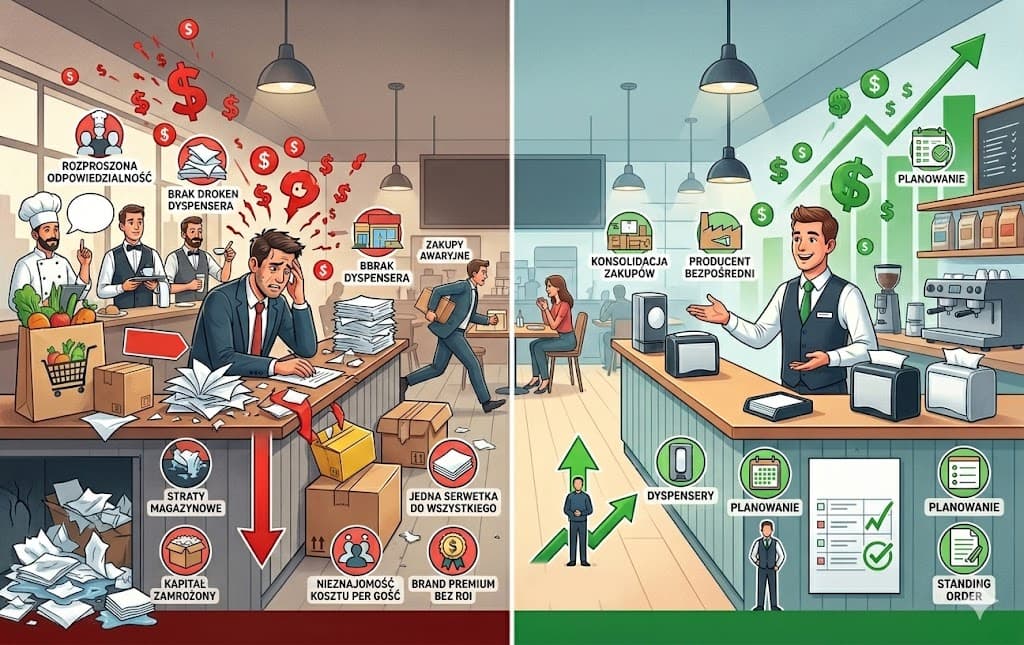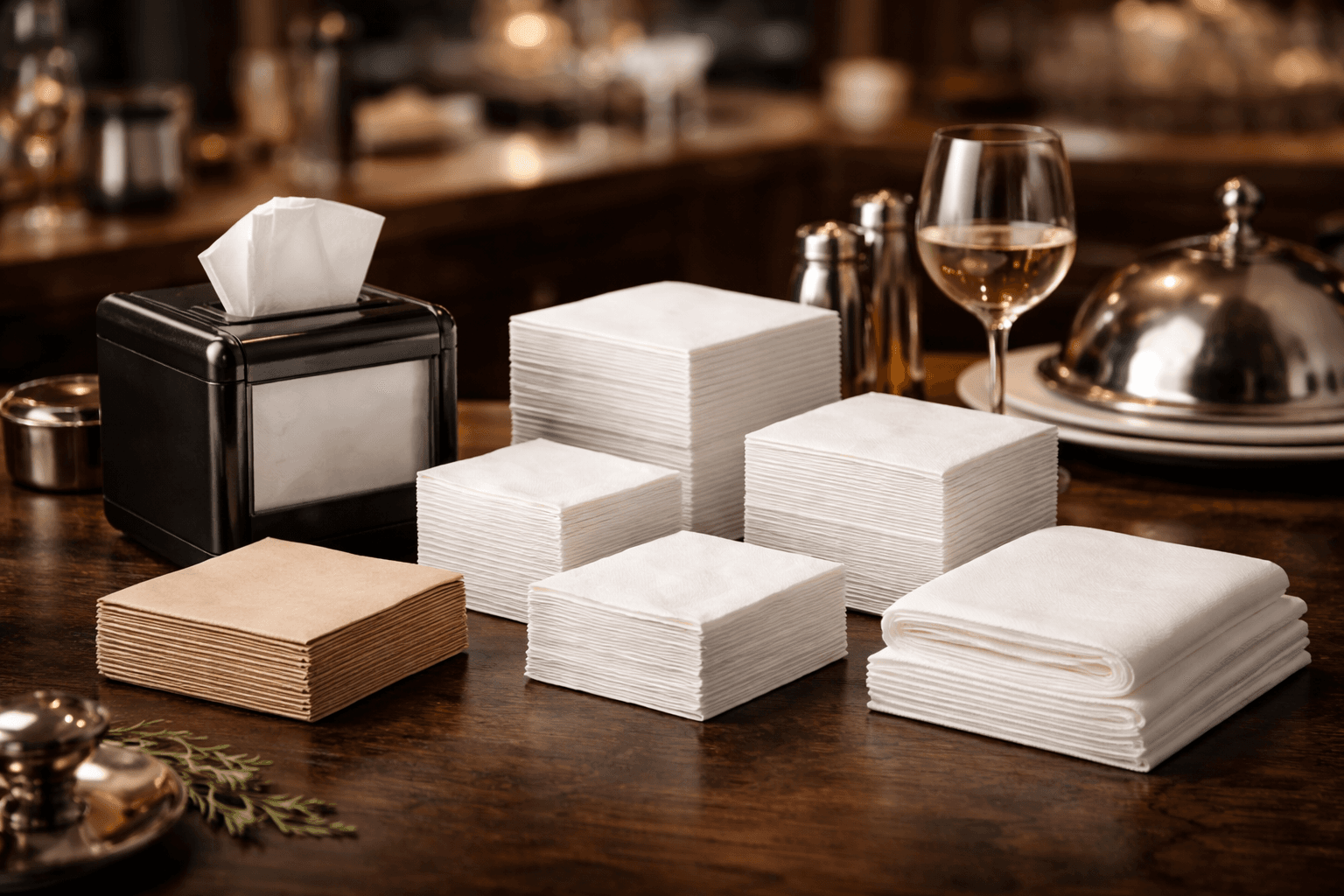
Napkins are one of those items that nobody thinks about until they run out. When they do, someone rushes to order whatever is available. That reactive approach — ordering in a hurry, at full price, in random quantities — is one of the most unnecessary cost leaks in hospitality.
This guide takes a different angle. Instead of just listing products and prices, we walk through a complete wholesale napkin strategy: how to measure what you actually need, where prices land in 2026, and how a zone-based product mix can trim your spending by a quarter or more. If you want a broad overview of napkin types first, start with our complete HoReCa napkin guide.
Step one: know your numbers
You cannot optimise what you do not measure. Before comparing suppliers or chasing quotes, spend one week tracking actual consumption. Grab a clipboard and record:
- How many packs get opened each day
- Where they go — tables, dispensers, kitchen, staff areas
- How much ends up unused or wasted
Most operators are surprised by what they find. The kitchen alone may account for 10–15% of total usage — napkins being used as makeshift cloths. That kind of waste is invisible until you measure it.
Calculating monthly demand
Once you have a week of data, scale it up:
Monthly usage = daily covers × napkins per cover × days open
Typical napkin consumption per guest:
| Venue type | Napkins per guest |
|---|---|
| Cafe or coffee bar | 1–2 |
| Casual dining | 2–3 |
| Full-service restaurant | 3–4 |
| Finger food, ribs, burgers | 4–6 |
| Buffet with dispensers | 1–2 |
Worked example: A 100-seat restaurant with 65% occupancy, lunch and dinner service, open 25 days per month:
- Daily covers: 100 × 0.65 × 2 = 130
- At 3 napkins each: 130 × 3 × 25 = 9,750 per month
- Add a 15% buffer for busy spells: approximately 11,200
A quarterly order of around 34,000 napkins puts you firmly in wholesale pricing territory.
What does it actually cost? 2026 wholesale prices
Below are approximate manufacturer prices per 1,000 pieces, net of VAT, collected from a European producer based in Poland. White napkins are listed first; eco variants (recycled or FSC-certified fibre) run around 5–15% higher.
White napkins — per 1,000 pcs
| Format | Size | 1-ply | 2-ply | 3-ply |
|---|---|---|---|---|
| Cocktail, straight edge | 15×15 cm | ~€1–1.50 | — | — |
| Cocktail, scalloped edge | 15×15 cm | ~€1.50–2 | — | — |
| Quarter-fold | 24×24 cm | ~€3–4 | ~€5.50–6.50 | — |
| Quarter-fold | 33×33 cm | ~€4–6 | ~€8–10 | ~€13–16 |
| Dispenser fold (1/8) | 33×33 cm | ~€5.50–6.50 | — | — |
Eco napkins — per 1,000 pcs
| Size | 1-ply | 2-ply |
|---|---|---|
| 24×24 cm | ~€3.50–4.50 | ~€6–7 |
| 33×33 cm | ~€5–6 | ~€9–11 |
> These figures are indicative. Your actual price depends on order volume, delivery terms and current pulp-market conditions. Orders above 50,000 pieces typically qualify for additional discounts. Custom-printed napkins start from roughly €8–13 per 1,000 — more on that in our custom-printed napkins article.
Putting it in perspective
Take our example restaurant using 11,200 napkins a month. If it buys only 2-ply 33×33 cm at €9 per thousand, that is about €100 per month. Switch to the zone-based mix described below — dispensers at the bar, two-ply on tables — and the bill drops to roughly €70–80. Over a year, that is €250–350 saved on a single consumable item, with no visible change for your guests.
The zone strategy: right napkin, right place
The single biggest cost lever is not the price per thousand — it is using the right product in the right spot. A three-zone approach works for most venues.
Zone 1 — Self-service (bar, counter, takeaway)
Use single-ply dispenser napkins. Guests pull one at a time, which slashes waste compared to open holders where people grab handfuls. Dispenser napkins also cost roughly half as much per piece as standard two-ply.
Zone 2 — Table service (dining room)
Two-ply 33×33 cm remains the workhorse. Good absorbency, a pleasant feel, and clean folding. This is where the bulk of your budget goes, so negotiate hard on this line.
Zone 3 — Premium moments (private dining, events, VIP tables)
Bring out three-ply or branded napkins with your logo only when the occasion calls for it. A printed napkin at a wedding reception makes an impression. The same napkin at a Tuesday lunch is wasted spend.
Venues that switch from a single product to this three-zone model typically see 20–30% lower napkin costs within the first quarter.
Read more about choosing between formats in our practical napkin buying guide.
Dispensers: small investment, fast payback
Switching to napkin dispensers in self-service areas is one of the quickest wins in hospitality cost management. Industry benchmarks show a 25–40% drop in consumption compared to open napkin holders.
The maths is simple: if guests take one napkin instead of three, and you serve 130 covers a day at the bar, that is roughly 260 fewer napkins wasted daily — nearly 7,000 per month. At dispenser-napkin pricing, the dispenser units themselves pay for themselves within weeks.
Where dispensers make the most difference:
- Breakfast buffets in hotels
- Fast-casual counters
- Food courts and canteens
- Takeaway and delivery stations
Order timing: quarterly beats ad-hoc
Panic ordering is expensive. When you run out on a Friday evening, you pay whatever the nearest wholesaler charges and accept whatever stock they have.
A quarterly ordering rhythm solves this:
- Forecast three months ahead using your consumption data
- Consolidate into one order — larger volume unlocks better unit prices
- Schedule staggered deliveries — for example monthly drops so you do not need excessive storage
- Build in a 15–20% buffer for peak periods
The benefit is not just price. Predictable orders build a stronger relationship with your supplier, leading to faster response times, priority during shortages, and willingness to accommodate last-minute changes.
Seasonal patterns to watch
Hospitality demand is cyclical, and your napkin orders should mirror that.
Peak periods (order more):
- Summer terrace and garden season
- Christmas, New Year, Easter — function bookings spike
- Local events, festivals, sports fixtures
Quieter periods (scale back):
- January and early February
- Post-holiday lulls
- Off-season in tourist destinations
A coastal restaurant may go through four times the napkins in July compared to January. Flat ordering means either running short in summer or sitting on surplus in winter. Align your volumes with your booking calendar and adjust each quarter.
What to look for in a supplier
Price matters, but reliability matters more. A supplier who delivers inconsistent quality or misses deadlines costs you far more in wasted stock and emergency reorders.
Hygiene and safety credentials
Paper napkins touch food and skin. Non-negotiable documentation includes:
- PZH certificate (or local equivalent hygiene attestation)
- FSC or PEFC certification for sustainably sourced fibre
- Compliance with EU food-contact material regulations
Our article on manufacturer vs. importer covers this in more depth.
Batch-to-batch consistency
Ask for samples from two different production runs. Compare feel, colour, embossing and absorbency. A dependable manufacturer delivers the same product every time — no surprises when you open the next pallet.
Flexibility and terms
Before committing to a long-term agreement, confirm:
- Free samples available before the first order?
- Trial order option to test logistics and quality?
- Payment terms — 14 days, 30 days, prepayment discount?
- Delivery included above a minimum spend?
- Clear returns and complaints process?
How to store napkins properly
Paper absorbs moisture, odours and UV light. Poor storage turns a good product into a waste of money.
Keep napkins:
- In a dry room, 15–25°C, humidity under 65%
- Away from cleaning chemicals, spices and fragrances — paper picks up smells fast
- On shelves, not on the floor, to avoid damp
- FIFO — first in, first out; use older stock before newer deliveries
- Unstacked from heavy items — crushed packs lose their fold and look cheap on the table
Properly stored, paper napkins last 2–3 years without quality loss.
Train your team — it costs nothing and saves plenty
Staff habits account for a surprising share of napkin waste:
- Waiters stacking five napkins per cover when two would do
- Kitchen staff using dinner napkins as cleaning rags
- Empty dispensers left unfilled, forcing waiters to hand out napkins from open packets
- New packs opened while older ones sit forgotten in the back
A ten-minute chat at a team briefing can cut consumption by 10–15%. Tell staff how much napkins cost per month — most have no idea — and the behaviour shifts on its own.
Quick-reference checklist
Before placing your next wholesale order:
- [ ] I have measured actual usage (not estimated)
- [ ] I use different napkin types for different zones
- [ ] I order quarterly, not when stock runs out
- [ ] Seasonal demand swings are reflected in order sizes
- [ ] A delivery schedule is agreed with the supplier
- [ ] Staff know how dispensers work and when to refill them
- [ ] Storage is dry, cool and odour-free
- [ ] I have tested samples and I am happy with the quality
- [ ] Supplier certificates (PZH, FSC) are on file
Wrapping up
Wholesale napkin purchasing is not complicated — but doing it well saves real money. The three moves that matter most:
- Measure — track consumption for a week and base orders on data
- Mix — use the right napkin in the right zone
- Plan — order quarterly, not reactively
Everything else — dispensers, seasonal adjustments, staff training — builds on that foundation.
Looking for a manufacturing partner who can put together the right mix for your venue? Get in touch — we will send samples and a tailored quote. Or take a look at our B2B offer to see how direct sourcing works.