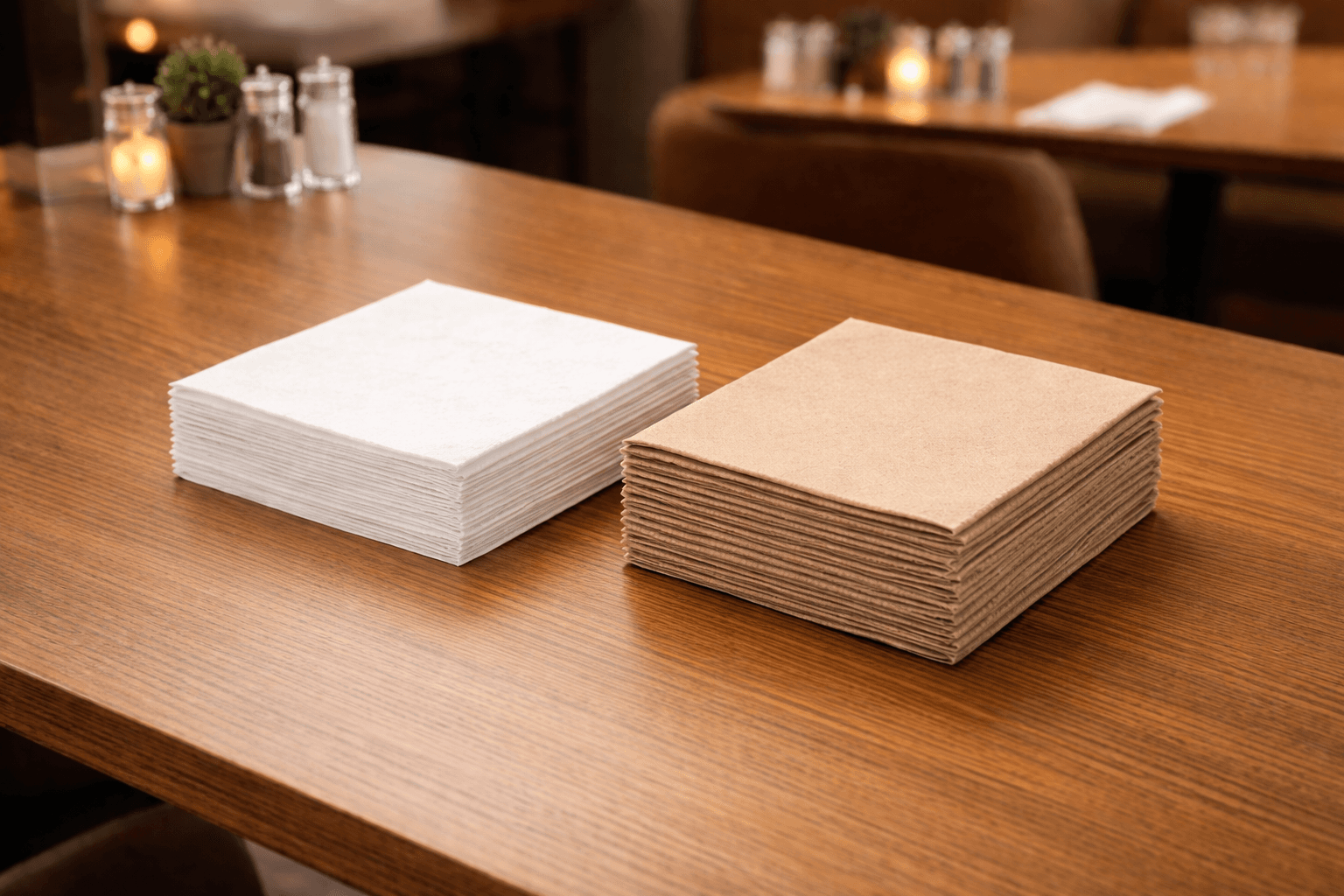
If you run a restaurant, hotel, catering company, or wholesale business, you'll eventually face the question: where should you buy napkins? The market offers two main options – direct from manufacturer or through a wholesaler/importer bringing products from abroad.
Both options have their merits. But the differences between them are bigger than you might expect.
What's the difference?
Manufacturer – A company that produces napkins in its own facility. You buy directly from the source, with no intermediaries. Check our B2B offer for businesses.
Wholesaler/Importer – A company that purchases finished napkins from abroad (often from China, Turkey, or Italy) and resells them locally. They add their margin and handle logistics.
At first glance – similar. But in practice, the differences are significant.
Price – where's the better deal?
The answer depends on order volume.
Small orders (hundreds to a few thousand napkins): Wholesalers may be cheaper or comparable. They have stock on hand, no need to start production.
Large orders (tens of thousands and up): Manufacturers are almost always cheaper. No intermediary margin translates to 15-30% savings.
Regular orders (monthly recurring): Manufacturers clearly win. Room for price negotiation, established terms, predictable costs.
A restaurant ordering 50,000 napkins monthly could save £600-1,200 annually by buying direct from manufacturer instead of through a wholesaler.
Quality – who provides better napkins?
This depends on the specific supplier, not the business model. But patterns emerge.
From manufacturers:
- You know exactly where the paper comes from
- You can visit the facility and see the process
- Easier to handle quality complaints
- Consistent quality across deliveries
From wholesalers:
- Product may come from varying sources
- Harder to verify production conditions
- Quality may fluctuate between batches
- Less control over specifications
Practical tip: Request samples and certifications. A good supplier – manufacturer or wholesaler – will provide them readily.
Customisation – printed napkins
Here the difference is clear.
Manufacturers:
- Full control over printing
- 1-3 colour printing on all formats
- Ability to modify designs
- Pre-production samples
- Design support available
Wholesalers:
- Limited options (pre-made designs)
- Often no custom logo capability
- Longer lead times (overseas production)
- Higher customisation costs
If you want napkins with your venue's logo – manufacturers are practically the only sensible option.
Lead times
Manufacturers:
- Standard orders: 5-10 working days
- Large orders: 10-14 days
- Rush options available for urgent needs
- Flexible schedules for regular customers
Wholesalers:
- In-stock items: immediate to a few days
- Items from abroad: 3-6 weeks
- Risk of international shipping delays
- Less flexibility
Wholesalers may be faster for small, standard orders. But for larger volumes or custom requirements – manufacturers are more predictable.
Supply reliability
This is crucial for hospitality. Running out of napkins is a problem nobody wants.
Manufacturers:
- Local production = shorter supply chain
- Lower delay risk
- Direct contact for problem-solving
- Quick response to urgent needs
Wholesalers:
- Dependent on global supply chains
- Risk of shipping delays
- Customs issues, port queues
- Less control over situations
Recent years have shown that local manufacturers are significantly more resilient to global disruptions.
When does a wholesaler make sense?
Buying from wholesalers works in specific situations:
- You need very small quantities for a one-off event
- You want a specific foreign brand
- You're testing the market and unsure of needs
- You need stock immediately (wholesaler has inventory)
When does a manufacturer make sense?
Buying from manufacturers pays off when:
- You order regularly and in larger quantities
- You value consistent, predictable quality
- You want napkins with your own branding
- You appreciate flexibility and direct contact
- Supply stability is a priority
Summary
There's no definitive "manufacturer or wholesaler" answer. The choice depends on your needs.
For most restaurants, hotels, and catering companies, working with a manufacturer will be more beneficial – lower prices on regular orders, better quality control, greater flexibility.
Wholesalers work for small, one-off needs or when seeking very specific products.
Best approach: test both options and compare not just price, but also service quality, reliability, and flexibility. These factors often determine long-term partnerships. Contact us – we'll answer all your questions.