Napkin size is a procurement decision that shows up in your cost report every month.
The wrong format means either too much consumption or a dissatisfied guest. The right match means lower cost per cover and a better service standard. This guide gives you the full specification for six HoReCa napkin formats: dimensions, ply, fold types and where each one belongs.
Why napkin size affects costs and service quality
The wrong choice creates one of two problems. A napkin that's too small – guests reach for more, consumption rises 50–200%. A napkin too large for the occasion – you overpay for a format you don't need.
Five specific consequences of the wrong size:
- Guests take 2–3 napkins instead of one – consumption up, savings gone
- Napkin incompatible with the dispenser – jamming, waste, staff time
- Fine dining with 15×15 cm or fast food with 3-ply 33×33 cm – equally expensive mistakes
- Dispenser napkins bought without checking the unit specification – first order goes in the bin
- One size for everything – you either overpay or guests are dissatisfied
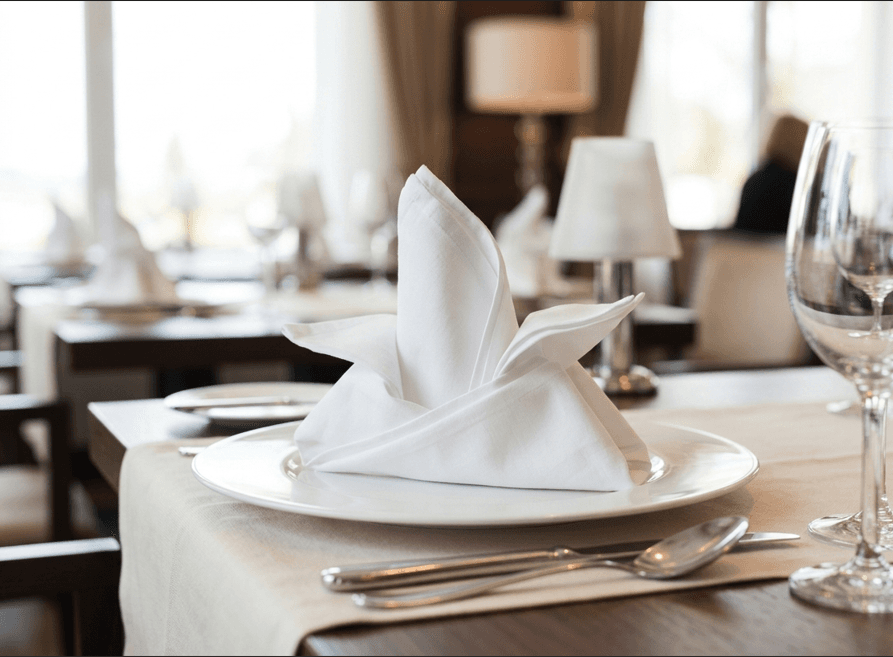
Size also has an aesthetic dimension. A folded napkin on the table sets the venue standard before the first course arrives.
All napkin formats – specification table
| Type | Size (cm) | Fold | Ply | Variants | Use |
|---|---|---|---|---|---|
| Plain / Scalloped | 15 × 15 | – | 1 | White, White+N | Fast food, bars, cafés, buffets |
| Cocktail | 24 × 24 | 1/4, 1/8 | 1–2 | White / Eco / +N | Cocktail bars, pubs, events, catering |
| Breakfast | 24 × 33 | 1/4, 1/8, 1/16 | 1 | White / Eco / +N | Hotels, breakfast, buffets, conference rooms |
| Dinner | 33 × 33 | 1/4, 1/8, 1/16 | 1–3 | White / Eco / +N | Restaurants, catering, banquets, weddings |
| Luncheon | 33 × 21 | 1/4 | 1 | White / Eco / +N | Bistros, lunch service, cafeterias, food courts |
| Dispenser | 33 × 33 | 1/8D | 1 | White / Eco | Self-service restaurants, fast food, petrol stations |
Key:
- N – available with logo print (1–3 colours)
- Eco – unbleached, biodegradable version
- 1/4, 1/8, 1/16 – fold types
- 1/8D – the N1-system fold with an offset, for dispenser units only
- Ply: economy (1), standard (2), premium (3)
How to read paper napkin dimensions
A common question in procurement: are the listed sizes folded or unfolded?
Dimensions on packaging and in product tables are always unfolded.
Folded sizes depend on the fold type:
Quarter fold (1/4)
Folded once across and once down:
- 33×33 cm → approx. 16.5×16.5 cm
- 24×24 cm → approx. 12×12 cm
- 24×33 cm → approx. 12×16.5 cm
The most common format for table service and hand delivery.
Eighth fold (1/8)
Three folds, result is a narrow rectangle:
- 33×33 cm → approx. 8.3×16.5 cm
Used in table napkin holders and as a folded presentation piece alongside cutlery.
Sixteenth fold (1/16)
Four folds, creates a compact rectangle or triangle:
- 33×33 cm → approx. 8.3×8.3 cm
Decorative fold for plate presentation in hotels and fine dining.
Dispenser fold (1/8D)
Not a visual variant – an N1-system fold in which the final panel sits shifted by a narrow strip (the offset). That strip gives fingers a grip on one napkin. Outside a dispenser, the 1/8D fold serves no purpose.
Plain and scalloped napkins 15×15 cm
The smallest HoReCa format. Available with a straight or scalloped edge – scalloping is purely aesthetic with no impact on function or price.
Specification: 1 ply, white or white with print. No fold – ready to use straight from the pack.
Where 15×15 cm works well
- Fast food and quick-service counters with self-service napkin holders
- Bars – coaster under espresso, tea or cold drinks
- High-turnover cafés (200+ customers per day)
- Breakfast buffets – supplementary napkin at the drink station
- Event counters, canteens, snack vending areas
Where 15×15 cm falls short
The 15×15 cm format cannot replace a meal napkin. At a table with food, guests will take several at once – eliminating any cost advantage immediately.
For menus requiring hand-wiping: supplement with luncheon 33×21 cm or replace entirely.
The 24×24 cm format (cocktail)
> More: for the full guide to this format — ply, colour and print for beverage service — see cocktail napkins for bars.
A format on the boundary between a support napkin and a full dining napkin. Large enough for finger food, small enough not to overwhelm a drink.
Specification: 1–2 ply. White, Eco or with print. Fold: 1/4 or 1/8. Folded quarter: approx. 12×12 cm.
Where cocktail napkins 24×24 cm work best
Cocktail bars and mixology venues. Folded to 1/8, it's a discreet coaster that absorbs condensation without visual bulk.
Pubs with bar snacks. With tapas, nachos or charcuterie boards – the right size. Guests don't need a full dinner napkin for a snack.
Standing events and finger food catering. The napkin fits the hand holding the canapé. In Eco version – a natural fit for companies with sustainability commitments.
Weddings and receptions. Alongside full place settings: at the buffet table and the bar.
1-ply or 2-ply?
1-ply: sufficient at the drinks counter. Basic absorbency, lowest cost per unit.
2-ply: for premium finger food events. Better durability, noticeably better feel in the guest's hand.
> Cocktail napkins 24×24 cm with logo print are one of the most cost-effective event branding materials. The logo stays in the guest's hand throughout the event – at a fraction of the cost of any other promotional item.
Breakfast napkins 24×33 cm
A rectangular format: wider than cocktail, narrower than full dinner. A deliberate cost-to-function optimum for light meals.
Specification: 1 ply. White, Eco or with print. Fold: 1/4, 1/8 or 1/16. Folded to 1/16 – a neat triangle or rectangle on the plate, the classic hotel breakfast presentation.
When breakfast napkins 24×33 cm are the right choice
Hotels with restaurant breakfast service. For a standard continental breakfast, 24×33 cm provides sufficient surface area. At 200–500 covers per day, the cost difference versus 33×33 cm shows up clearly every month.
Buffets and conference rooms. A napkin at a training session doesn't need to be a full dinner napkin. Folded to 1/8 – neat alongside coffee and pastries.
Guesthouses and B&Bs. A higher standard than plain 15×15 cm, lower cost than full 33×33 cm.
Why not use 33×33 cm at breakfast?
Two reasons.
Cost. The 33×33 cm format at the same ply count costs more. At high volumes the difference accumulates monthly.
Proportion. A full dinner napkin alongside coffee and a croissant looks oversized. The 24×33 cm format is built precisely for this type of service.
Dinner napkins 33×33 cm
The HoReCa industry standard. The widest range of ply (1, 2 and 3), variants and fold types of any format in the range.
Specification: 1–3 ply. White, Eco or with print (1–3 colours). Fold: 1/4, 1/8 or 1/16. Folded quarter: approx. 16.5×16.5 cm. Folded eighth: approx. 8.3×16.5 cm – standard table napkin holder format.
Three quality levels
1-ply. 16–18 g/m². High-turnover venues where unit cost is the priority. Sufficient for simple dishes.
2-ply. 32–38 g/m². Optimal absorbency and durability for normal use. Standard for casual dining, pizzerias, pubs and corporate catering.
3-ply. 48+ g/m². Guests feel the quality difference immediately. Fine dining, 4–5 star hotels, premium banquets and weddings.
Where 33×33 cm is irreplaceable
- Table-service restaurants for lunch and dinner
- Banquet halls and weddings – folded to 1/8 or 1/16 as a place setting element
- Corporate and event catering
- Hotels – à la carte restaurant and room service
- Fine dining with decorative plate folds
Eco variant
Unbleached, biodegradable dinner napkins for restaurants with environmental certification or a sustainability policy. The natural ecru tone fits organic, farm-to-table and slow food venues perfectly.
Luncheon napkins 33×21 cm
Designed precisely for quick lunch service in casual venues. Folded quarter: approx. 16.5×10.5 cm – enough for a lunch at the table, compact for service.
Specification: 1 ply. White, Eco or with print. Fold: 1/4.
Where luncheon napkins 33×21 cm are the right choice
Bistros with set lunch menus. Built for the lunch break format – adequate for a sandwich, soup, salad or light set meal.
Cafeterias and canteens. Cost matters, guests expect functionality. The right economic choice here.
Food courts and shopping centres. High footfall, short table time, lunch menu – the ideal profile for 33×21 cm.
Corporate canteens. Counter or self-service at breakfast and lunch. Lower paper consumption per cover than 33×33 cm.
In institutional catering this is the baseline format, and the number per cover is set by the operator rather than by the guest. Choice and cost per meal served are covered in the guide to napkins for canteens.
When luncheon napkins 33×21 cm fall short
Burgers, ribs, seafood, pizza at the table – guests will take several luncheon napkins instead of one dinner napkin. The cost advantage disappears.
For intensive main courses: use a 2-ply dinner napkin 33×33 cm.
Dispenser napkins 33×33 cm (1/8D fold)
Same unfolded dimensions as dinner napkins – but folded differently. The 1/8D fold is the N1 system: an eighth-fold with an offset, its final panel shifted so a strip projects past the flush edge of the stack.
Specification: 1 ply, 16–19 gsm. White or Eco. For dispensers only – one system, 1/8D (N1).
How the 1/8D fold works
The napkins lie one on top of another and their offsets form a ridge across the top of the stack that can be felt as well as seen. Fingers land on a strip belonging to one napkin, and that strip guides the grip. Nothing advances by itself – which is why the stack must keep its height and compression.
Why food service operations choose dispenser systems
Consumption control. 25–40% less waste compared to an open napkin holder.
Hygiene. No contact with napkins the guest doesn't take. HACCP-compliant for food environments.
Less staff time. Guests help themselves; staff don't need to refill napkin holders constantly.
Less bulk extraction. The offset gives an unambiguous grip on a single sheet, which an open holder never offers.
Cleaner service area. A wall-mounted or table dispenser is a tidy fixture in any self-service zone.
Before ordering: it is one system, so there is no format to match to a model. What actually decides the outcome is different – where the unit stands and at what load level it gets replaced. The unit belongs at the pickup point rather than on the table, and it is replaced at about one third of its load.
Format matching guide
| Venue type | Format | Ply | Variant |
|---|---|---|---|
| Fine dining | 33×33 cm | 2–3 | White or Eco |
| Casual dining / pizzeria | 33×33 cm | 2 | White or printed |
| Fast food / QSR | Dispenser 33×33 (1/8D) | 1 | White |
| Hotel – restaurant | 33×33 cm | 2–3 | Printed (logo) |
| Hotel – breakfast buffet | 24×33 cm | 1 | White or Eco |
| Bar / cocktail bar | 24×24 cm | 1–2 | White or Eco/N |
| Café | 24×24 cm + 33×21 cm | 1–2 | Eco / white |
| Bistro / canteen | 33×21 cm | 1 | White or Eco |
| Event catering | 33×33 cm | 2–3 | Printed / Eco |
| Food truck | 33×21 cm or dispenser | 1 | White |
| Petrol station with food | Dispenser 33×33 (1/8D) | 1 | White |
Detailed selection guide for restaurants
1-ply vs 2-ply – what does the extra layer actually do?
| Parameter | 1-ply | 2-ply |
|---|---|---|
| Typical grammage | 16–18 g/m² | 32–38 g/m² |
| Absorbency | Basic | 2–2.5× higher |
| Wet strength | Low | Good |
| Unit cost | Lowest | Approx. 40–70% more |
| Consumption per cover | 1.5–2× higher | Standard |
| Cost per cover | Comparable or higher | Optimal |
| Typical use | Dispensers, drinks, self-service | Standard and premium dining |
The rule that changes purchasing decisions: cost per unit ≠ cost per cover.
With 1-ply, guests reach for another napkin because the first saturated or tore. With 2-ply, one usually does the job. Switching from 1-ply to 2-ply dinner napkins often doesn't increase the monthly cost – reduced consumption compensates for the higher unit price.
When 1-ply is sufficient:
- Dispensers – the 1/8D fold already limits consumption mechanically
- Under drinks: plain 15×15 cm and cocktail 24×24 cm
- Hotel breakfast service at high daily volumes
When 2-ply always pays off:
- Table dining where the guest holds the napkin throughout the meal
- Dishes requiring intensive hand cleaning
- Any segment where napkin quality affects the perceived standard of the venue
Most common mistakes in napkin size selection
1. Standing the dispenser on the table instead of at the pickup point.
Guests then take a reserve at the start of the meal and the saving disappears. Napkins are served where the guest collects the food.
2. Using 15×15 cm plain napkins as the only format at dining tables.
A guest eating a main course will take four instead of one. No saving here.
3. 3-ply dinner napkins in fast food.
Ten minutes at the table and a burger is not a scenario for premium napkins. Over-spec with no return.
4. Three different formats in one venue.
Complicates ordering and stock management. Maximum two: a primary and a supplementary format.
5. Evaluating cost per unit instead of cost per cover.
The only operationally meaningful metric: how much does it cost to serve one guest?
6. Luncheon napkins 33×21 cm for an intensive main course menu.
Ribs, burgers, seafood – guests take several. Back to point 5.
7. Ignoring Eco where it carries brand value.
An organic café or farm-to-table venue without certified napkins contradicts the brand profile. Eco napkins are available in all formats.
Napkin size is a technical purchasing decision with a measurable monthly impact on operating costs. The right format, the right ply, the right system – an optimisation that shows up in every cost report.
Dinner napkins · Dispenser napkins · Eco napkins · Printed napkins · B2B for HoReCa