Pizza looks like the easy case. One product, eaten by hand, and the napkin exists to wipe fingers. The numbers rarely behave, though, because a pizzeria is really two venues sharing a kitchen: the dining room and the delivery operation. Each consumes napkins by a different logic, and only one of them lets you correct anything while it is happening.
In the room, a guest who was given too few reaches for another. In a box that has already left, nobody reaches for anything. That is the entire difference, and it reverses the way ordering works: the room forgives a mistake in the count, delivery preserves it.
What follows takes both channels apart. Why the unit in delivery is the order rather than the box, what happens to a napkin sealed in with a hot pizza, and where in the box it needs to sit to arrive dry. Written from the perspective of the manufacturer who folds the tissue.
Table of contents
- A pizzeria is two venues on one kitchen
- Dine in: pizza is eaten by hand
- Delivery: the order is the unit
- What steam does inside a closed box
- Where in the box the napkin goes
- Collection is a third channel
- One ply or two for pizza
- Size: the full sheet, not the half
- White or Eco in a pizzeria
- Print in the delivery box
- How much to order: dine in and delivery separately
- Most common mistakes
- Checklist before ordering
- Key takeaways
A pizzeria is two venues on one kitchen
The room and the delivery operation share dough, an oven and a payroll. Beyond that they have little in common, and the napkin is one of the places where the difference shows most clearly.
In the room the napkin is continuously available. It sits on the table, in a holder or at the collection point, and the guest regulates the quantity. Your decision is about quality and format, because the number settles itself during the meal.
In delivery the napkin is issued once, at packing, by someone who can see neither the table nor the number of people. The decision is made in the kitchen, a quarter of an hour before anyone checks it. There is no regulation, only a hit or a miss.
That has a purchasing consequence. The room needs a napkin that performs well as a single sheet, because the guest takes another when needed. Delivery needs a set that performs well as a set, because the set is everything the customer will get.
> In short: the room and delivery are two channels with different consumption mechanics. The room lets you correct the count mid meal, delivery lets you correct nothing. Count them separately from day one.
Dine in: pizza is eaten by hand
Pizza is one of very few restaurant dishes that most venues serve without cutlery. That is a technical parameter rather than a cultural note, because it changes the contact area.
With a plated dish the napkin meets fingertips and the corners of the mouth. With pizza it meets the whole palm, the inside of the fingers and the wrist, and it does so repeatedly through one meal, because oil and sauce return to the hands with every slice. That is where the higher per guest figure comes from, at the same headcount as a plated restaurant.
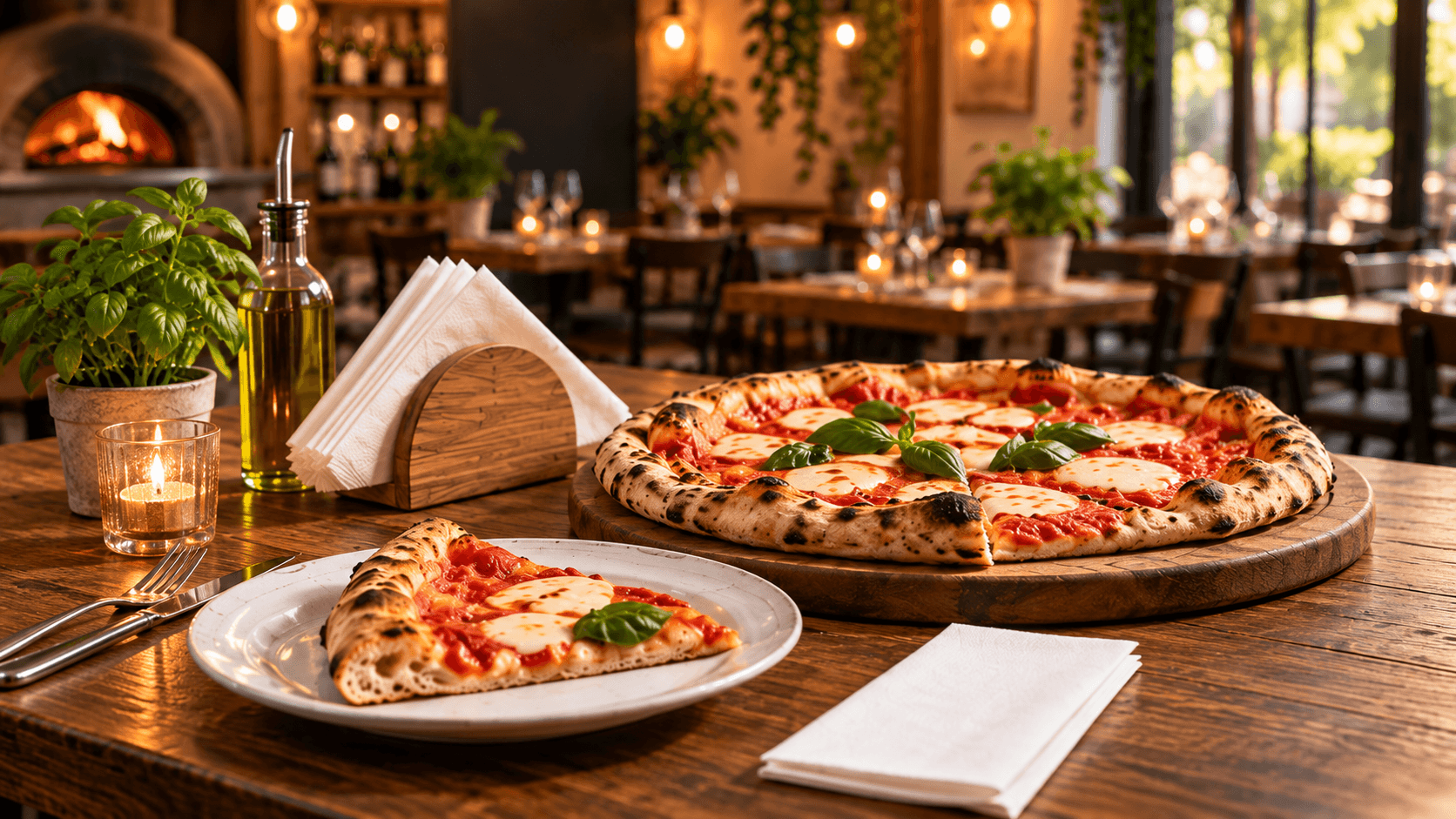
The second thing specific to a pizzeria room is the surface role. A slice put down for a moment lands on a napkin, because the plate is occupied by the rest of the pizza or there is no plate at all. Here the napkin works as a surface rather than a cloth, and that is a job where size matters more than plies.
The third is drinks. Pizzerias sell a lot of cold drinks, and a glass with ice sheds condensation onto the table. Part of the room's napkin consumption goes on water rather than grease, and that share never shows up against the food.
Friday and Saturday evening concentrate all three at once. The room fills, the drinks turnover is at its highest and the kitchen is under delivery pressure at the same hour, which is exactly when a table holder runs empty and nobody notices.
Delivery: the order is the unit
The most common mistake in this channel is a mistake of unit. The kitchen counts napkins per box, because the box is what it sees at packing. The customer consumes them per person, because that is how they sit down.
A 12 inch pizza is usually one person. A 16 to 18 inch is two or three. An order with two large pizzas and sides is most often a table of four to six. Pack two napkins per box and that table receives four sheets for six people, which is the moment a comment appears in the app.
The figure we use across hospitality is three napkins per person. Applied to delivery it means you derive the number of people from the size and count of the pizzas, then multiply. That is the whole method, and it is cheaper than not having one, because a single refund absorbs the saving from several hundred boxes.
It is worth knowing what the channel actually costs before economising on it. In venues where delivery passes 40% of turnover, disposables reach 8–12% of operating costs, against 3–7% in a venue without delivery. The napkin is one of the cheaper items in that basket and one of the few the customer examines at close range. The full mechanics of cutting disposable costs are in our guide to reducing disposable costs.
What steam does inside a closed box
This is the part nobody sees at packing, and it decides what condition the napkin arrives in.
A pizza out of the oven gives off steam for a good fifteen minutes. In a closed box that vapour has nowhere to go, so it condenses on the cooler surfaces: the underside of the lid, the walls and anything lying inside. Vents in the board reduce the effect without removing it.
Cellulose tissue takes up that moisture passively. Nobody has to use it, it only has to be there. One ply holds 16–19 gsm and that is its entire absorbency budget, so twenty minutes in a humid interior consumes a meaningful part of it. The customer opens the box and receives a napkin that is already half spent, although nobody has touched it.
Grease adds to this. A napkin is not a grease barrier; oil passes through tissue and leaves a translucent mark. That rule holds across the category and we work through it in our guide to napkins for cafés and bakeries. In a pizza box it takes a sharper form, because grease pools on the base of the board and whatever lies there sits in it for the whole route.
The conclusion is about position rather than product. A napkin in a pizza box ages with the delivery time, and the only thing you control is where exactly it lies.
> In short: in a closed hot box the napkin works without the customer. Better paper will not change that; placement will.
Where in the box the napkin goes
The order from worst to best is unusually clear here.
- Under the pizza. The worst place available. Grease drains there and condensation collects on the base. The napkin arrives soaked and greasy at once, and often tears when pulled out.
- On top of the pizza. Slightly better, but the sheet lies on the hottest surface and collects steam at source. It also sticks to the cheese.
- Flat against the edge, clear of the pizza. A reasonable compromise when the napkin has to travel inside. Moisture still reaches it, but more slowly, with no contact with hot dough.
- Tucked under the lid fold. Good in summer, worse in winter, because a large temperature difference puts most of the condensation on the lid.
- In the bag, outside the box. The best option and the only one that takes the napkin out of the steam cycle entirely. It asks nothing except that whoever packs treats napkins as a line of their own rather than an accessory to the board.
The list is short, but this is one of the few changes in a pizzeria that costs nothing. No change of product, supplier or price, only a different habit at the packing bench.
Collection is a third channel
Most operations describe themselves as having two channels, dine in and delivery. In practice there is a third one, and it is the one that generates complaints nobody can trace.
Collection looks like a walk in at the counter and behaves like a delivery. The customer takes the box away, and then eats at home, at a desk or in the car. There is no table, no holder and nobody to ask. Whatever went into the bag is the whole provision.
The failure is structural rather than careless. Till systems separate collection from delivery cleanly enough, but packing staff associate the napkin pack with the courier bag, because that is where the pack physically lives. An order that leaves through the front counter skips the step. The ticket says fulfilled, the box looks complete and nothing flags.
It is worth checking because the symptom is misleading. Complaints appear scattered across days and drivers with no pattern, so they get read as random. Split your last month of feedback by channel instead of by day and the concentration usually appears immediately.
The fix is a line on the ticket rather than a briefing. Print the napkin count on the collection ticket the same way it appears on a delivery ticket, and keep a pack within reach of the front counter, not only at the courier bench. Bank holiday weekends and big sporting fixtures are worth watching specifically, because that is when collection volume rises fastest and the counter is busiest.
There is a second reason to treat this channel on its own terms. A collection customer has already made a trip, so their tolerance for a missing item is lower than a delivery customer's, and they are more likely to mention it at the counter next time rather than in the app.
One ply or two for pizza
This looks like a quality decision and it is an arithmetic one. One ply is 16–19 gsm. Two 1-ply sheets in the hand come to 32–38 gsm, exactly what one 2-ply sheet gives.
With pizza the guest almost always takes more than one sheet, so the question is not one ply or two, it is how much total weight you are supplying. In the room the answer settles itself, because the guest takes more. In delivery you make that decision for them.
In a box, 2-ply has one concrete practical advantage: at the same total weight you pack fewer sheets, so they are easier to position clear of the pizza and less likely to shift in transit. That is a logistics argument rather than a quality one, but it counts for more in this channel. The full comparison is in our guide to 1-ply and 2-ply napkins.
Size: the full sheet, not the half
The right format for a pizzeria is 33×33 cm, and it follows from how pizza is eaten.
The napkin meets a whole palm, so the sheet has to cover it. Smaller formats, the 33×21 cm lunch sheet included, push people to take two at once, which cancels the saving on format and worsens the impression, because the guest can see that one is not enough. The same sheet is also the only one that works as a surface for a slice set down mid meal.
33×33 cm is the standard hospitality sheet, the same one a plated restaurant uses. The full map of formats and their applications is in our guide to paper napkin sizes.
White or Eco in a pizzeria
Both versions are defensible here, and the difference is not absorbency, since both are cellulose tissue.
White is neutral and works wherever the napkin sits on the table next to the food and simply should not draw attention. It is also safer where the menu runs to pale sauces and dusted finishes, since a mark shows less on white than on unbleached paper.
Eco in unbleached paper suits pizzerias that build their story on sourdough, a wood fired oven or local sourcing. It has an extra argument in delivery specifically: the pizza box is board, so an Eco napkin and the packaging go into one waste stream after the meal with nothing to separate. We cover the category in our guide to eco napkins.
Print in the delivery box
A pizzeria is the exception among takeaway channels. In a pastry bag or a patisserie box print usually goes unseen, because the customer opens the packaging briefly. A pizza box gets opened and stays open for the whole meal, with the napkin beside it on the table, sometimes for an hour.
That makes it one of very few materials from the venue that physically reaches a customer's home and gets looked at there. Print selection, colour counts and when it stops paying are handled separately in our guide to logo napkins. One planning point matters here though: printed napkins carry a longer lead time than plain, 7–14 days against 3–5 days, so they are ordered ahead rather than in the week they run out.
How much to order: dine in and delivery separately
A single venue average hides where consumption actually happens and makes correction impossible.
Count both channels separately over four weeks. The room: guests multiplied by consumption per guest. Delivery: orders multiplied by napkins per order, derived from people rather than boxes. Add them only at the end, when you place the order with the manufacturer.
Keeping them apart matters for a second reason: the balance between channels moves on a weekly rhythm in your own venue. Weekend evenings are delivery, weekday lunch is the room. Look at one monthly figure and you cannot see which channel grew. Stock calculation, reorder points and safety buffers are covered in our guide to how many napkins to order.
Most common mistakes
- Counting napkins per box instead of per person. The leading cause of delivery complaints. A large pizza is two or three people, not one package.
- Leaving collection orders out of the napkin count. The ticket reads fulfilled and the box looks complete, so the gap never flags.
- The napkin under the pizza. It arrives soaked in grease and condensation at once, and tears on the way out.
- A smaller format to save money in delivery. The customer takes two, so the saving disappears and the impression remains.
- Ordering printed napkins in the week they run out. Print is 7–14 days, plain is 3–5 days.
- Treating a napkin as a liner between dough and board. That is greaseproof paper's job, not cellulose tissue's.
- One combined figure for the room and delivery. It makes it impossible to see which channel drove an increase.
Checklist before ordering
- Count guests in the room and delivery orders separately for the last four weeks.
- Add collection as its own line rather than folding it into either of the other two.
- Convert delivery orders into people using pizza size and count, not box count.
- Fix one napkin figure per order and write it up at the packing bench.
- Decide whether the napkin travels in the box or in the bag, and write that up too.
- Test it: send one order out on a normal route and open it yourself before handover.
- Choose 33×33 cm for all channels so you are not running two lines without reason.
- Choose between white and Eco on the menu and the packaging, not on unit price.
- If you are planning print, order 7–14 days ahead.
Key takeaways
A pizzeria consumes napkins through channels with different mechanics. The room lets you correct the count mid meal, delivery gives you one attempt at packing time. Everything else follows from that.
In delivery the unit is the order converted into people, not the box. Three napkins per person applied to the real headcount at the table resolves most complaints in this channel.
Collection is a third channel that most operations count as one of the other two. It behaves like delivery and gets packed like a walk in, which is why its complaints look random.
A napkin sealed in with a hot pizza works without the customer, absorbing steam for the whole journey. Better paper will not fix it; position will, clear of the pizza and preferably outside the box.
The format is the same across channels: 33×33 cm, because pizza is eaten with a whole hand. Plies are a question of total weight rather than quality, since two 1-ply sheets equal one 2-ply.
Gastronomic napkins 33×33 cm · Eco napkins · Printed napkins · B2B for HoReCa