The cocktail napkin is the smallest item at the bar and, for that reason, the most often overlooked. Yet it lands under the glass with every drink, ends up in the guest's hand, and shapes a first impression before anyone says "cheers." A thin, rustling napkin that collapses under a sweating glass quietly undercuts an otherwise careful bar.
This isn't a general size chart — that lives in our guide to paper napkin sizes. Here the focus is drinks service only: how to match the format, grammage, colour and print of a cocktail napkin to a bar, a cocktail bar, a hotel or an event, written by a manufacturer that makes these napkins and specs them for individual venues.
Cocktail, beverage or bar napkin — a quick word on terms
The names overlap, and it helps to know they describe the same thing. "Cocktail napkin," "beverage napkin" and "bar napkin" all refer to the small drinks-service format — most often 24×24 cm, sometimes 15×15 cm. What sets them apart from a "dinner" or "luncheon" napkin isn't a different product family but a different job: a dinner napkin (33×33 cm) serves food at the table, while the cocktail napkin serves the glass and the hand. When you brief a supplier, the size and ply matter more than which of these labels you use.
What a cocktail napkin actually has to do
Before comparing formats, it's worth being clear about the work. At the bar a cocktail napkin does four jobs at once, and each sets a different requirement.
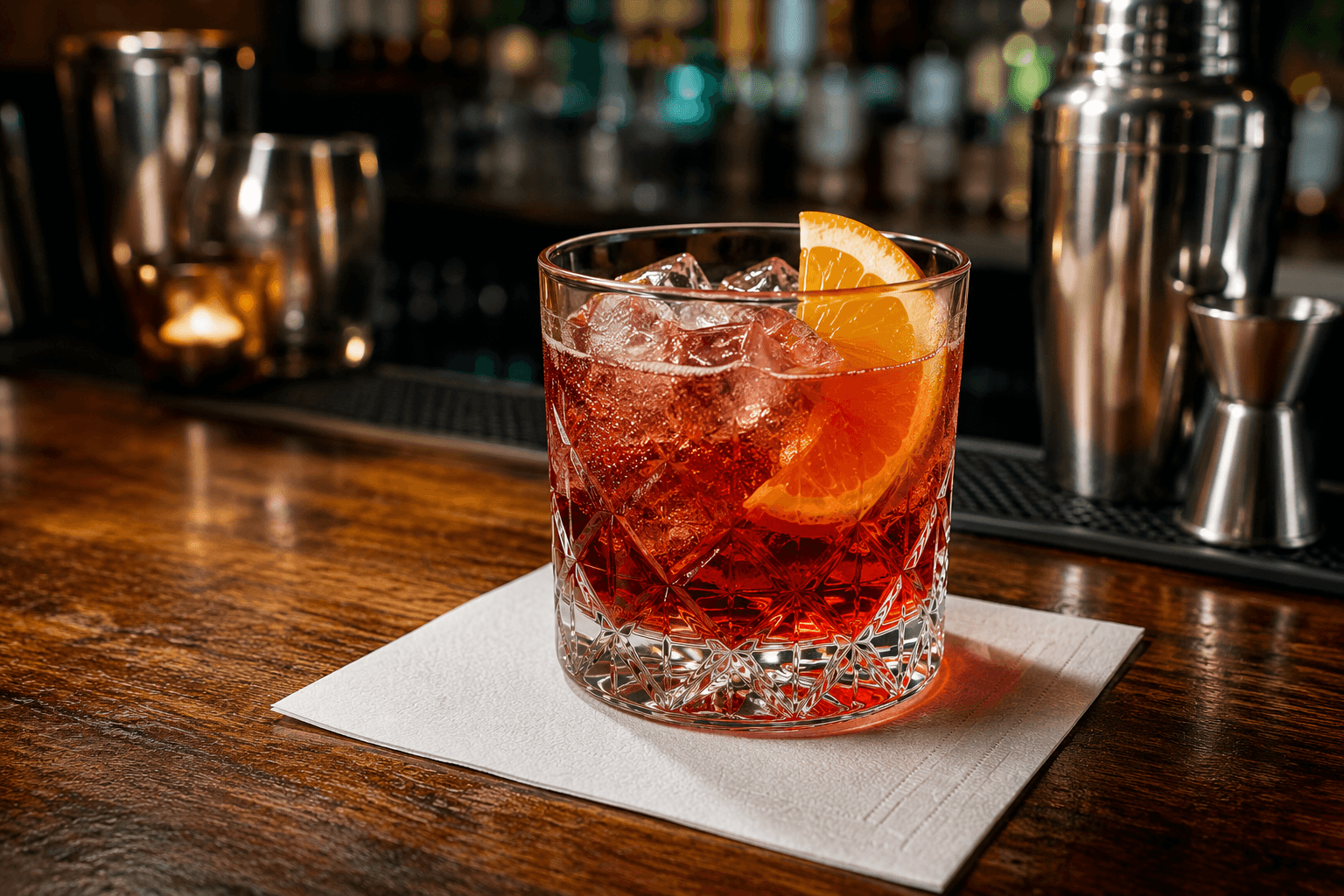
It coasters a sweating glass. A cold drink in a warm room condenses moisture on the glass; that water rings the counter and makes the glass slip. A napkin under the base takes it up — but only if it has the fibre to do so. That's requirement one: absorbency.
It backs a bite. Nuts, olives, tapas, a cheese board, a slice eaten standing — anything picked up alongside a drink needs a napkin as a small plate and a finger-wipe. That's where format starts to decide.
It keeps the station clean. A folded, single napkin handed out with the drink signals a cared-for bar. A scattered pile by the taps, or napkins pulled from a tub with wet fingers, undoes that fast.
It carries the brand. The guest holds it for the length of the drink — longer than they read the menu. It's the cheapest ad space a bar owns, and most leave it blank.
Size: 24×24 vs 15×15 cm
Two formats do the real work at the bar, and the difference isn't "big and small" — it's two roles.
15×15 cm is a pure coaster. It tucks under a glass, cup or flute, stays discreet and costs least per piece. It fits where there's no food with the drink: a coffee bar, a drinks-only service, a hotel minibar, a welcome glass.
24×24 cm is the bar's all-rounder. It coasters a drink like the 15×15 cm, but it also has the surface to back a hand-held bite and genuinely wipe fingers after tapas or wings. It's the safe choice wherever drinks arrive with something to eat.
The consequence is measurable. Too small a napkin against a "messy" snack means the guest reaches for a second and a third — the cheaper piece works out dearer per serve. Too big under a lone cocktail is wasted cost and looks fussy. If your bar mixes drinks with small plates, it's usually best to standardise on 24×24 cm and add 15×15 cm only in a drinks-only zone; one dominant format simplifies ordering and cuts mistakes. When the "bar" turns into table service, step up to the breakfast 24×33 cm or the classic 33×33 cm — the full map is in our napkin sizes guide.
| Situation at the bar | Format | Why |
|---|---|---|
| Cocktails and drinks, no bite | 15×15 cm | Discreet coaster, lowest unit cost |
| Coffee, tea, hot drinks | 15×15 cm | Enough for a cup and spoon |
| Drinks with finger food (nuts, olives) | 24×24 cm | Drink and bite in one hand |
| Tapas, cheese board, bar snacks | 24×24 cm | More surface for eating by hand |
| Event drink bar / welcome drink | 24×24 cm | Versatile, and good as a logo carrier |
| Hotel minibar, welcome set | 15×15 cm | Neat and compact beside two glasses |
Ply and grammage — how absorbency works
Absorbency isn't magic; it's fibre. A single ply is typically 16–19 g/m². Two plies work out at roughly 32–38 g/m², three at about 48–57 g/m². More fibre means more room for water and more strength once the napkin is wet.
At the bar, though, plies behave differently than at the main course — the task is taking up a thin film of condensation and a little grease from a snack, not scrubbing a heavy sauce.
- 1-ply — enough under drinks alone. Basic absorbency, lowest cost, ideal in high-turnover bars where a fresh napkin goes out with every drink anyway.
- 2-ply — the standard for a premium bar and food events. It holds in the hand, doesn't disintegrate against a wet glass and clearly lifts the sense of quality. Beside a pricier cocktail, the feel is part of the experience.
- 3-ply — rarely earns its keep at the bar. It belongs where the napkin does real cleaning, i.e. table service.
A two-second test settles it: drop the napkin on a bead of water. A good one draws it in within 2–3 seconds; a weak one smears and starts to pill. Then wipe a damp counter — it shouldn't shred or leave lint. For a full ply comparison on grammage, absorbency and wet strength, see 1-ply vs 2-ply napkins.
The fold: 1/4 or 1/8
How the napkin performs and looks by the glass depends on the fold as much as the size.
- 1/4 fold (a square) gives a larger, flat face — good when the napkin also backs a bite or when you want the print on show.
- 1/8 fold gives a smaller, thicker pad — better as a pure coaster, concentrating absorbency and sitting tidily under a flute without bulk.
For print, the fold has a hard consequence: only part of the napkin shows once folded. A logo centred on the open sheet can vanish into the crease or land face-down. Always design for the folded face.
Colour: white, kraft-tone Eco or black
Colour is a styling choice that shapes the room more than its price suggests.
White is universal and hygienic — cafés, hotels, daytime service, anywhere a clean, neutral message counts. Without a clear reason to do otherwise, choose white.
Kraft-tone Eco. In an unbleached version the natural, faintly beige tone reads as "sustainable" at a glance — a fit for speciality coffee, local-produce venues and places with a green policy, since the Eco line is biodegradable and carries FSC/ISEGA certification. The fibre can feel a touch less soft than premium white; in return the material itself carries the message.
Black or charcoal belongs to the evening bar and the cocktail bar. It hides drink and juice marks, looks right in low light and completes the mood. Treat it as a deliberate accent, not a default — in a daytime bar a dark napkin can feel out of place. More on the return of dark napkins in the premium segment in our 2026 hospitality trends.
On a dark napkin with a print or QR code, leave a light panel — a dark mark on a dark ground is unreadable to the eye and the phone camera alike. And before a large colour run, check on a sample that the paper doesn't tint a damp hand.
Printing your logo
This is the small format's most wasted function. The napkin under a drink stays in the guest's eyeline the whole time, and a photogenic cocktail carries your logo into the background of social posts at no extra media cost.
What to know before you print:
- Technique. Flexographic printing with water-based, food-contact-safe inks, usually in 1–3 colours. Print resolution reaches 120 lpi, which keeps a logo and simple graphics crisp.
- File. Supply the logo as vector art so it stays sharp at any scale; low-resolution raster art prints with ragged edges.
- Design for the fold. As above — what shows on the folded face is what counts.
- Run and lead time. Print carries a minimum order and a longer lead time than plain white: unprinted white usually ships in 3–5 days, printed napkins in 7–14 working days plus artwork and sample approval. On small one-off runs the per-unit print cost is high; it pays off on repeat orders.
The economics are simple: in a bar serving several hundred guests a day, print costs a fraction of a cent per brand contact — at the moment of genuine enjoyment. We go deeper in personalised napkins and logo napkins in restaurant marketing, and ready options are in our printed napkin range.
Events, weddings and catering
Beyond the fixed bar, the cocktail napkin comes into its own wherever drinks are served standing and at volume.
Drink bar and welcome drink. A glass on arrival, a cocktail bar through the party, a drinks station beside the buffet — 24×24 cm is the default, covering both drink and bite. Printed, it becomes part of the event's look, tied to the invitations or theme.
Weddings and celebrations. The classic dinner napkin takes the laid table, but the bar and buffet belong to the cocktail format — and it's the natural place for personalisation around the couple or occasion.
How many — a worked example. A 150-guest reception, bar open all evening, bites at the bar: 4 napkins per guest is 600 pieces, plus a 15% buffer ≈ 690 for the bar alone. Add a welcome-drink zone and the buffet and you're comfortably over a thousand for one event. That's why usage is calculated per event, not eyeballed. The step-by-step method, with buffer and seasonality, is in how many napkins to order. For a printed version, order ahead — production takes 7–14 days.
Cocktail napkin or coaster?
A common either/or: napkin or a rigid coaster? They aren't rivals but two different tools.
- A coaster is rigid, reusable or single-use. It protects the counter and builds a lasting visual for the station, but it won't wipe a hand or back a bite. It's part of the bar's set dressing.
- A cocktail napkin is single-use, absorbs condensation, backs a bite and stays fresh and hygienic for every guest — and it's cheaper per contact and easy to brand.
Well-run bars often use both: a rigid coaster as a fixed accent and a cocktail napkin with every drink. If you must choose one, the napkin is more versatile — it covers more situations at a comparable cost.
Common mistakes when choosing cocktail napkins
- Buying on unit price, not cost per serve. The cheapest thin napkin, taken two or three at a time, can cost more than one that actually absorbs.
- Sizing too small for the food. 15×15 cm under wings or tapas forces repeat grabs and looks stingy.
- Going dark without a sample. You risk paper that tints a damp hand, or an unreadable print.
- Designing the logo on the open sheet. It disappears in the fold.
- Ordering print at the last minute. Ignore the 7–14 day lead time and the napkins won't make the event.
- Skipping samples before a big run. Absorbency and feel are judged on the product, not the spec sheet.
How to order: samples, minimums, lead times
Three steps before a large order. First, samples: test absorbency under a sweating glass, wet strength and feel in your own venue. Second, the spec: fix format, ply, colour, fold and any print; for print, ask about the minimum order and supply vector artwork. Third, timing: plain white ships faster (usually 3–5 days' production), printed runs 7–14 working days plus artwork.
As a manufacturer we match format, grammage, Eco version and print to a specific venue and send samples before the order — with no importer margin in between. The range is under gastronomic napkins, and wholesale terms are on our B2B page.
Summary table
| Criterion | Basic choice | Premium / event choice |
|---|---|---|
| Format | 15×15 cm (drink only) | 24×24 cm (drink + bite) |
| Ply | 1-ply | 2-ply |
| Fold | 1/8 (coaster) | 1/4 (coaster + print) |
| Colour | white or kraft Eco | black (evening bar) |
| unprinted | bar logo / event theme | |
| Segment | high-turnover bars | cocktail bars, events, weddings |
Pre-order checklist
- [ ] Is there a bite with the drink? (if yes → 24×24 cm)
- [ ] Is the drink premium and should the guest feel it in hand? (if yes → 2-ply)
- [ ] Does the bar run in the evening and build atmosphere? (consider black)
- [ ] Do I need a visible "green" signal? (consider unbleached Eco)
- [ ] Do I want the napkin as a brand carrier? (design print for the fold)
- [ ] Do I have food-contact approval confirmed and — for Eco — FSC/ISEGA?
- [ ] Have I calculated event demand with a buffer and print lead time?
- [ ] Have I ordered samples and tested absorbency under a sweating glass?
Key takeaways
- A cocktail napkin is a drinks-service format — coaster, bite, hygiene and brand in one, not a smaller dinner napkin.
- 24×24 cm when there's a bite, 15×15 cm when it's the drink alone. One dominant format simplifies storage and cuts errors.
- Absorbency comes from grammage and ply (one ply 16–19 g/m²). 1-ply for high-volume service, 2-ply for a premium bar and finger food.
- Colour is styling: white is universal, kraft Eco carries a natural message, black suits the evening bar — always leave a light panel for a QR code.
- Print turns the napkin into the cheapest brand carrier — designed for the fold, in 1–3 colours, flexographic.
- At events, plan 3–6 napkins per guest and order ahead, especially with print.
- A manufacturer gives flexibility and samples before you commit — format, ply, Eco version and print matched to your bar.
> Choosing cocktail napkins for a bar or event? We'll help you pick the format, ply, colour and print for your venue. Free samples and prices direct from the manufacturer — get in touch, or see the B2B wholesale offer.