Ask a wholesaler which napkin a coffee shop needs and you will get an answer in centimetres. Ask an operator which one actually works and you get a story about a customer with greasy fingers, or a napkin that went translucent under a cup, or a printed one that nobody ever saw.
The gap between those two conversations has a single cause: dimensions describe the product, but they don't describe the job. And in a café — unlike a restaurant — the job varies enormously within one venue, because the same paper is asked to survive anything from thirty seconds to forty minutes in a customer's presence.
Contact time is the number that actually predicts what you need. This guide is organised around it. For the full catalogue of formats see our paper napkin sizes guide; here we look only at coffee, bakery and delivery service, from the perspective of the manufacturer that makes the stock.
Contact time as the specification driver
Sort your service by one question: how long does the napkin stay with the customer?
The answer splits a café into four distinct jobs, and each one wants a different product. Note what happens at the extremes — the shortest and the longest contact both want cheap and good for completely different reasons, and getting them the wrong way round is the most expensive mistake in this category.
| Contact time | Where it happens | What the napkin actually does | Specification |
|---|---|---|---|
| ~0 seconds | Delivery bag, grab-and-go bag | Nothing. Often never unfolded | Cheapest 1-ply, 24×24 cm, white, no print |
| 1–3 minutes | Counter handover, eating on the move | Holds the product, protects the hand | 2-ply 24×24 cm — fat is the constraint |
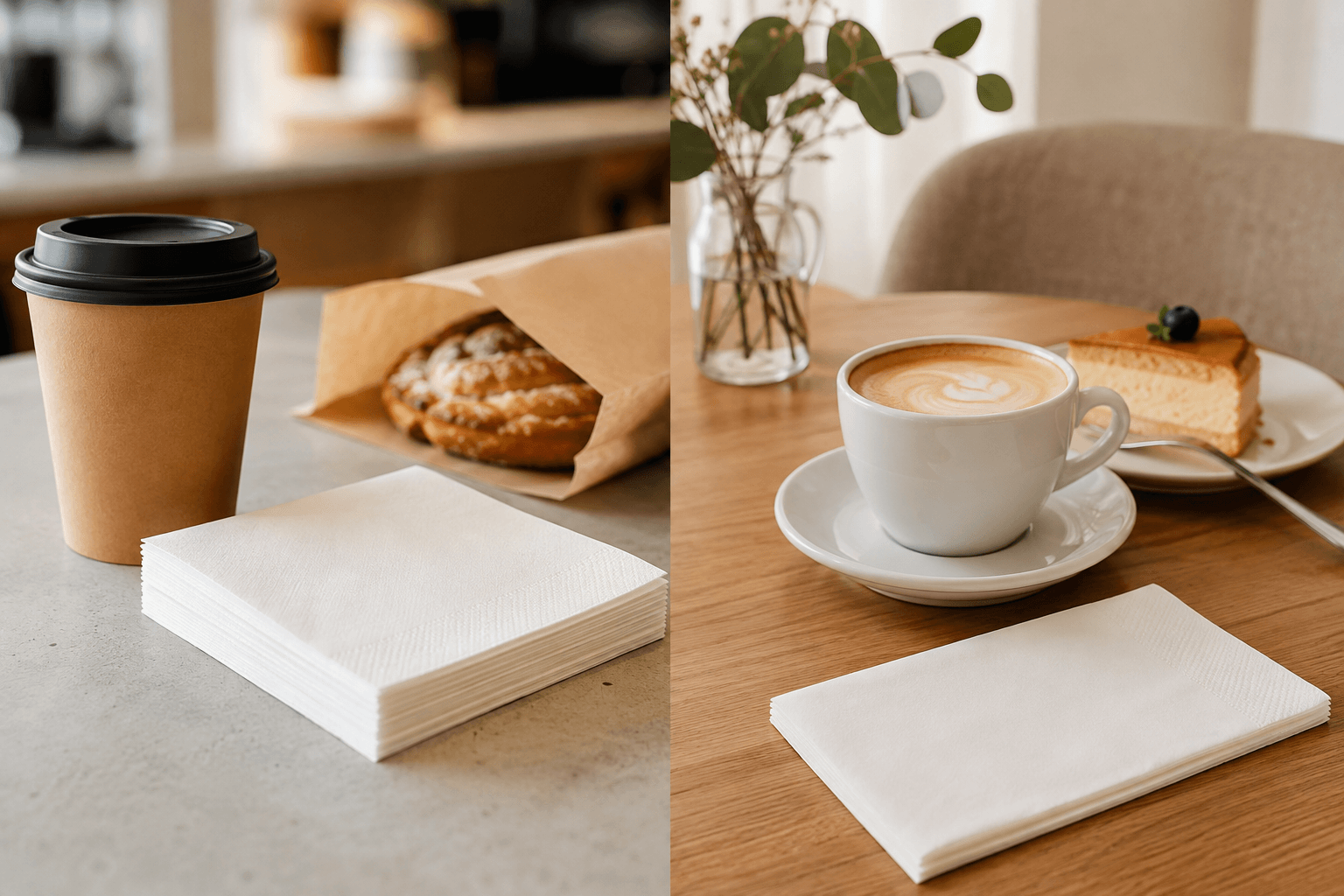
| 10–20 minutes | Coffee and cake at a table | Underlay, wipes fingers, part of the setting | 2-ply 24×24 cm, white or Eco, print pays here |
| 40+ minutes | Long dwell, laptop customers | Becomes a coaster; must still look clean | 2-ply 24×24 cm, wet strength is the constraint |
Two things fall out of this table immediately. First, three of the four rows land on the same format — 24×24 cm — which is why format is a weak lever in a café and ply is a strong one. Second, the only row that genuinely wants a different product is the zero-second one, and it is usually the row with the largest volume. That is where the money is.
> In short: In a café, ply and print placement are the decisions that matter. Format is close to fixed. Sort your volumes by contact time and you will find that your largest volume needs your cheapest product — which is the opposite of how most venues buy.
Zero seconds: the napkin in the delivery bag
This is the fastest-growing volume in most coffee shops and the least examined line on the order. It deserves its own section because almost everything a napkin is for stops applying.
A napkin dispatched through a third-party delivery platform is handed to a courier, carried in a sealed bag, delivered to a home or an office, and unpacked by someone who already owns kitchen roll. It comes out folded. It goes in the bin folded. Contact time with the customer is effectively zero, and visual contact time is barely better — the napkin is under the box, face down, for the entire journey.
That has three consequences worth acting on:
Specify the cheapest single-ply you stock. There is no absorbency requirement to meet, because nothing is being absorbed. There is no grip requirement, because nothing is being held. Whatever quality argument justifies your table napkin does not reach this bag.
Never print for delivery. A printed napkin in a delivery order is the clearest example of paid-for brand contact that never happens. If you want branding in that bag, it belongs on the box, the sleeve or the sticker — surfaces the customer looks at while unpacking.
Include one anyway. Leaving the napkin out entirely reads as cost-cutting and generates complaints out of proportion to the saving. The right answer is not omission, it is the floor of your range.
If delivery is a meaningful share of your turnover and you are currently sending your table napkin out in those bags, this single split is very likely the largest napkin saving available to you — larger than any price negotiation on the product itself. The wider arithmetic on disposables sits in reducing disposable costs.
One to three minutes: the counter handover
Here the napkin does the most physical work it will ever do, and grease is the whole story.
At the counter the napkin holds the product. A croissant handed across the counter does not sit beside the napkin, it sits in it. The customer closes the napkin around a warm pastry and walks out with it. For those two or three minutes it is simultaneously a tong, a plate and a wrapper.
Why grammage doesn't predict this
Grammage describes fibre per square metre and predicts water absorbency well. A single ply is typically 16–19 g/m², two plies roughly 32–38 g/m², three around 48–57 g/m². Water is bound by the cellulose and stays in the structure of the paper.
Fat does not behave that way. It has lower surface tension, so it migrates more readily along and through the sheet, filling the voids between fibres. The result is visible: a translucent grease mark you can see from the other side. That means the fat has gone through the paper, not been absorbed by it.
So a napkin with excellent water absorbency can put butter on a customer's hand in seconds. The standard water test will never reveal it.
The 30-second grease test
Run this alongside the water-drop test, not instead of it:
- Fold the napkin the way you actually use it at handover.
- Put the greasiest item in your display on it — a croissant, a doughnut, a sausage roll.
- Wait 30 seconds and lift the napkin.
- Check the underside.
A translucent mark underneath means that napkin, at that ply count, will not protect your customer's hand with that product. Two conclusions only: add a ply, or change the tool.
Where a napkin ends and greaseproof paper begins
It needs saying plainly, because the expectation runs the other way too: a paper napkin is not a grease barrier and never will be. Resistance to fat migration comes from a surface barrier, which is a separate product category — greaseproof, glassine, bakery wrapping paper — not a napkin variant.
At the counter a napkin gives a hygienic grip, wipes fingers and stands in for a plate. If the product must stay wrapped longer than the handover, you need barrier paper and the napkin complements it. Specifying two plies instead of the correct wrapper is a classic route to disappointment with the product.
Ten to twenty minutes: coffee and cake at a table
This is the row where quality is visible and where print earns its keep.
The napkin lies beside the cup for the length of the visit, goes under a cake and into a hand. With cream, whipped cream and mousse the constraint shifts from absorbency to wet strength: a single-ply sheet comes apart under the finger pressing a slice against a fork and carries the cream onward instead of collecting it. Two plies here are a matter of function, not impression. The full ply comparison against grammage and wet strength is in 1-ply vs 2-ply napkins.
This is also the only row where printing makes commercial sense. Coffee with cake is the most photographed combination in hospitality, the napkin is in frame beside the cup, and the customer keeps it for longer than a bistro meal lasts.
Practical points on print: flexographic, water-based food-contact-approved inks, one to three colours, resolution to 120 lpi. Supply the logo as vector. Design for the fold — only part of the sheet is visible once folded, and on 24×24 cm that is a sharper constraint than on 33×33 cm. Plain white runs in three to five days, printed stock in 7–14 working days plus artwork and sample approval; for seasonal designs the clock starts at approval, not at order. More in personalised napkins and QR codes on napkins, with the range in printed napkins.
Forty minutes and up: the laptop customer
The long-dwell customer is now a defining segment of the independent coffee shop, and they use a napkin in a way no other customer does — which makes this the row most often specified wrong.
Someone working for an hour over one flat white does not really wipe anything. What they do is set the cup down on the napkin and leave it there. The napkin becomes a coaster. Over forty minutes it takes condensation from the cup, the drip from the rim, a ring from the base, and it stays in view on the table the entire time, next to a laptop, often photographed, often the only piece of your branding within reach.
That inverts the usual requirement. Absorbency barely matters — the volume of liquid is trivial. What matters is how the sheet looks after forty minutes of slow wetting. A single ply goes translucent, cockles at the edges and starts to stick to the cup base. It reads as a cheap venue precisely in the segment that scrutinises you hardest and stays longest.
Two practical consequences:
Never put single-ply on a long-dwell table. The saving is a fraction of a penny per service and the cost is your only visible branded surface looking degraded for the whole visit.
Test for the long wet, not the fast wipe. Put a cold drink on a folded sample and leave it for forty minutes. Then look at it. If you would not want that sheet photographed next to your cup, it is the wrong product for your tables — regardless of how it performed on the two-second water drop.
There is a pricing argument here too. A customer occupying a table for an hour generates less revenue per minute than three customers in sequence, so the temptation is to cut cost on them. The napkin is the wrong place to do it: it is one of very few things that stays continuously in their field of view.
Format: why 33×33 cm is surface you pay for and nobody uses
Three of the four contact-time rows land on 24×24 cm, so it is worth stating why the large format is not on the table.
The classic 33×33 cm catering napkin is designed for a cover: on the lap or under cutlery beside a main course. A café has no main course, no cover and no full cutlery set — it has a cup, a saucer and a pastry fork. The large format therefore adds no function; it adds surface the customer will not use and a cost paid on every service. Moving from 33×33 cm to 24×24 cm changes nothing about coffee with cake and lowers the unit cost.
The boundary is real, though. The large format earns its place again the moment a café starts serving plated meals — lunch, salads, hot dishes. At that point it is no longer a café in service terms and restaurant logic applies. And where sandwiches, toasties and paninis are on the menu, 33×21 cm is the right answer for the tables: more surface for eating by hand without paying for a cover-sized sheet. Both formats are set out in the sizes guide.
White or Eco
White stays universal and hygienic — the safe default for the counter, daytime service and every bag that leaves the building. Icing sugar is practically invisible on it, an advantage with dusted pastries.
Eco — unbleached, naturally light beige — is the obvious choice for specialty coffee, venues built on local produce and craft bakeries. The paper carries the message on its own, and the line is biodegradable and covered by FSC/ISEGA certification. Worth knowing: none of our napkins, white or ecological, is chlorine-bleached; the difference is the bleaching process, not safety. More in eco napkins.
Two checks on a sample before you commit: how icing sugar looks on it, because a white film on beige shows more than you expect, and how it sits against your crockery and takeaway cups, because in a café the napkin appears in photographs beside the cup.
> In short: White handles dusted pastries better and belongs in every bag. Eco is the stronger brand signal on the tables, where it is actually seen.
How many to order
At the same customer count a café orders more napkins than an à la carte restaurant. Three reasons combine: customers take stock themselves from the counter and take it with a margin, grab-and-go and delivery generate consumption independent of use, and rotation over a cup is faster than over lunch.
Plan for three per customer, but cost the zero-second volume separately from the table volume — that is the split the contact-time table exists to reveal, and a single blended average hides it completely. The calculation method with buffers and seasonality is in how many napkins to order.
The most common mistakes
- Specifying by dimension instead of contact time. Format is nearly fixed in a café; ply and placement are the real decisions.
- Sending your table napkin out in delivery bags. Usually the single largest avoidable napkin cost in a delivery-heavy venue.
- Printing for delivery or grab-and-go. Paid brand contact that never occurs.
- Single-ply on long-dwell tables. It goes translucent under a cup and degrades your most visible branded surface.
- Testing absorbency with water only. The water test says nothing about butter reaching a customer's hand, or about how a sheet looks after forty minutes.
- Expecting a grease barrier from a napkin. Separate product category; a thicker napkin is not a wrapper.
- Single-ply with cream products. It comes apart in the fingers and smears the cake.
- Choosing Eco without a sample when the display is dusted. A white film on beige is clearly visible.
- A logo designed on the flat sheet. On 24×24 cm very little survives the fold.
Summary table
| Venue type | Highest-volume contact row | Specification | Where print goes |
|---|---|---|---|
| Specialty coffee shop, seated | 10–20 min | 2-ply 24×24 cm Eco at tables | tables only |
| Coffee shop with heavy delivery | ~0 sec | cheapest 1-ply in bags, 2-ply at tables | tables only |
| Espresso bar, coffee to go | ~0–1 min | 1-ply 15×15 or 24×24 cm | not worth it |
| Bakery counter, no seating | 1–3 min | 2-ply 24×24 cm (fat is the constraint) | optional |
| Bakery-café | split ~0 sec / 10–20 min | two lines, cheapest and 2-ply | tables only |
| Patisserie | 10–20 min | 2-ply 24×24 cm white | yes |
| Laptop-heavy independent | 40+ min | 2-ply 24×24 cm, tested for long wet | tables — highest return |
| Café with a lunch menu | 10–20 min | 33×21 cm 2-ply at tables | tables only |
Checklist before ordering
- [ ] Have I sorted my service volumes by contact time rather than by menu section?
- [ ] Is the cheapest single-ply going into delivery and grab-and-go bags?
- [ ] Have I removed print from every bag the customer does not open?
- [ ] Have I run the grease test with the fattiest item in the display?
- [ ] Have I left a cold drink on a folded sample for forty minutes and looked at it?
- [ ] Do cream products get two plies?
- [ ] Do I need barrier paper for wrapping, alongside the napkin?
- [ ] Have I checked Eco on a sample — with icing sugar and against my crockery?
- [ ] Is the print designed for the folded napkin, and does it land where a customer will see it?
- [ ] Do I have confirmed food-contact approval and, for Eco, FSC/ISEGA?
Key takeaways
- Contact time predicts the product; dimensions don't. Sort your volumes by how long the napkin stays with the customer.
- Your largest volume usually needs your cheapest product. Delivery and grab-and-go have near-zero contact and no absorbency requirement.
- Print belongs at the tables and nowhere else. In a closed bag it is paid brand contact that never happens.
- Grease passes through paper; water stays in it. Run the grease test and check the underside — the water test cannot see this.
- A napkin is not a grease barrier. For wrapping you need barrier paper; the napkin complements it.
- Long-dwell customers use the napkin as a coaster. Test for slow wetting over forty minutes, not for the fast wipe.
- 24×24 cm covers three of the four contact rows. Format is a weak lever in a café; ply is the strong one.
- Eco is the stronger signal where it is seen — on the tables. White belongs in every bag that leaves the building.
> Choosing napkins for a café, bakery or patisserie? We'll sort your volumes by contact time, set the ply count against your own products and prepare the print for the surfaces where it is actually seen. Free samples and prices direct from the manufacturer – get in touch or see our B2B wholesale offer. The full range of formats is in gastronomic napkins, and the unbleached line in eco napkins.