A dispenser rollout rarely fails on day one. It fails quietly, site by site, over the first two months — and by the time consolidated spend is reviewed, nothing looks wrong enough to investigate.
That pattern has a mechanical explanation. A dispenser does not save napkins because it is a dispenser. It saves them because one pull gives one napkin, and only while it genuinely does. What makes that happen is a single detail of the fold that no specification sheet mentions: the offset.
This guide takes that detail apart, then covers the three situations that switch it off — all three operational, none requiring a different product. It is written for estates rather than single sites, so it also covers the wording that carries the rules into opening and closing checklists, and a five-minute audit that finds the cause on the floor without waiting for data. Written from the perspective of the manufacturer who folds these napkins.
Table of contents
- Rollout is where the saving is won or lost
- The offset: the whole mechanism in one crease
- A dispenser napkin is a full 33×33 cm sheet
- Three situations where the dispenser stops saving
- Where to place the serving point
- Writing it into the standard: the lines that survive turnover
- The five-minute site audit
- Single-ply — and why the second napkin is not waste
- Single-use cardboard versus a permanent dispenser
- White or Eco in a dispenser
- How to measure whether it paid off
- Most common mistakes
- Pre-order checklist
- Key takeaways
Rollout is where the saving is won or lost
For a single independent site, dispenser napkins are a product decision. For a chain of quick-service restaurants, forecourt bistros or food-court units, they are an operating-procedure decision — and that is a different problem with a different failure pattern.
The failure pattern is worth naming up front, because it shapes everything below. A multi-site rollout does not fail all at once. It fails site by site, quietly, over the first two months. One general manager packs the unit as full as it will go, because refills cost labour. Another lets it run to empty before swapping, for the same reason. A third moves the units onto the tables during a shift when the floor looks untidy, and nobody moves them back. Each of those three decisions is locally reasonable. Each one cancels the saving at that site.
What makes this hard to catch is the reporting layer. Head office sees consolidated napkin spend, which moves with traffic, seasonality and purchase price. A site that has lost the whole effect is invisible inside that number — it looks like a busy month.
So the practical rule for any estate above one location: the three failure modes below belong in the opening and closing checklist, not in a briefing. A briefing is heard once by the people present that day. A checklist survives staff turnover, and staff turnover is precisely what erodes a rollout.
> In short: A single site chooses a product. An estate chooses a procedure. Put the three failure modes on the checklist and report napkins per guest per site — consolidated spend will hide the site that broke.
The offset: the whole mechanism in one crease
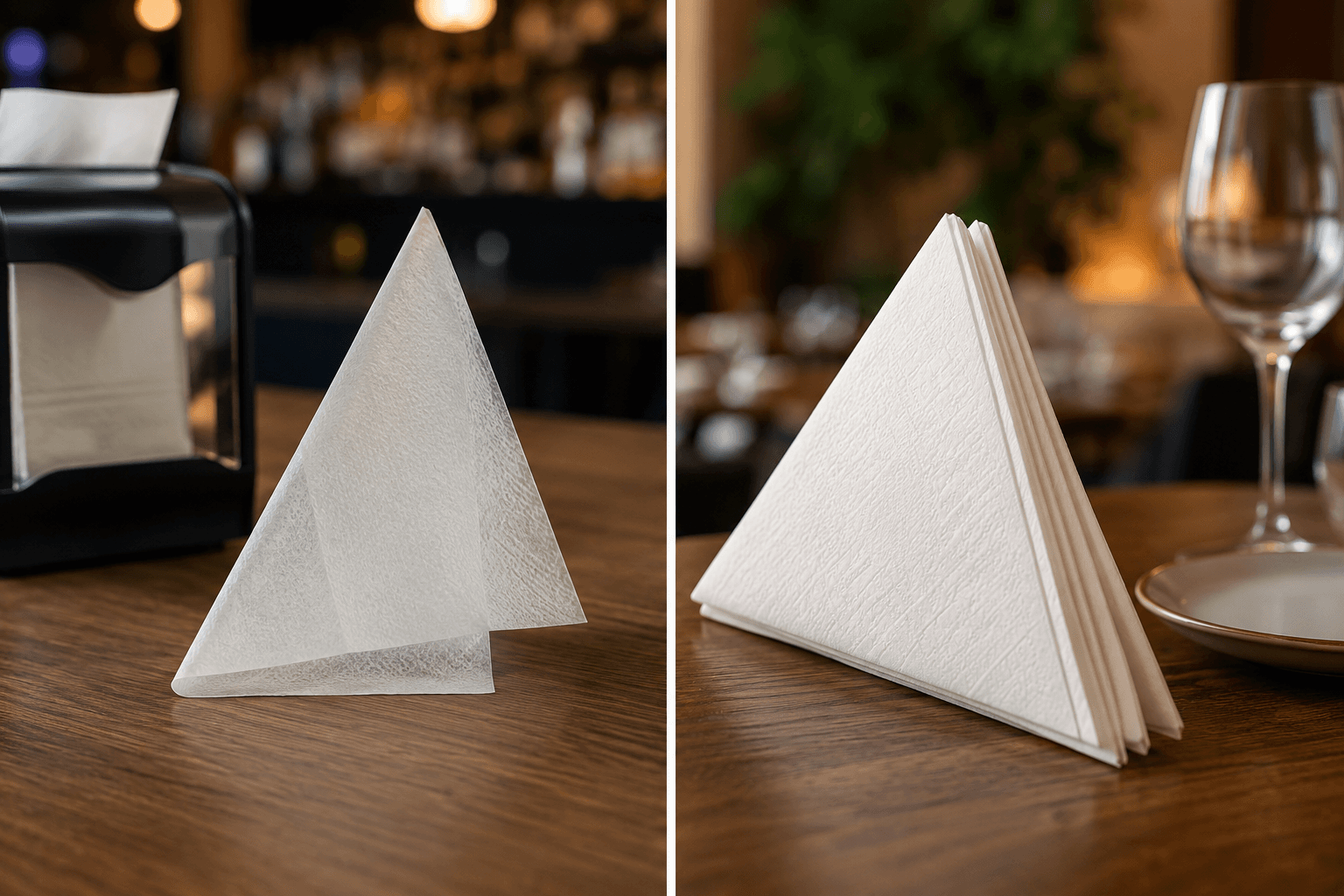
Dispenser napkins are folded in the 1/8D system, designated N1. The D does not refer to the number of creases — an eighth is an eighth — but to what separates this format from a plain 1/8 fold: the offset.
The offset is a deliberate shift. The final panel does not line up with the others; it sits back by a narrow strip that projects past the otherwise flush edge. When the napkins are stacked inside the unit, those strips form a visible, and more importantly a tactile, ridge across the top of the stack.
That is the entire mechanism. The guest's fingers do not have to hunt for an edge or peel apart sheets that have settled together — they land on a projecting strip that belongs to one napkin. The grip is unambiguous because the paper itself indicates where it ends.
It is worth being clear about what the offset does not do, because a stronger promise circulates in this category. Removing a napkin does not push the next one up and does not present it automatically. There is no mechanism here to present anything — there is an arrangement of paper that offers a fresh grip at the top of the stack each time. The distinction matters in practice: because nothing advances by itself, the stack has to keep its height and its compression for the offset to stay findable. That is exactly what breaks in the three situations below.
A dispenser napkin is a full 33×33 cm sheet
The most common misunderstanding in this category is about size. The phrase dispenser napkin sounds like a separate, smaller, cheaper product — something between a napkin and a paper slip.
Unfolded, it is 33×33 cm: precisely the same sheet as the classic catering napkin used in restaurants and event catering. Only the fold changes. A guest pulling one out of the unit receives a full-size napkin, simply served one at a time instead of sitting in a basket.
Two practical consequences follow.
First: do not compare unit prices across formats. If you are putting a dispenser-napkin quote next to a 24×24 cm quote, you are comparing two different sheets. The comparable equivalent is the classic 33×33 cm at the same ply count.
Second: a dispenser is not automatically the downgrade option. An operator who rejects dispensers for fear of lowering the standard of service is usually comparing them with an impression rather than with the product. The full format works in favour of perception too — unfolded, the napkin looks like what the guest expects.
The full map of the other formats and folds is in our guide to paper napkin sizes.
Three situations where the dispenser stops saving
A consumption reduction of 25–40% against an open holder is a real figure, but it is not a property of the equipment. It is a property of the situation in which one pull produces one napkin. The three situations below break that link, and they are almost always what sits behind the verdict that dispensers changed nothing here.
1. Overpacking
A duty manager loading up before a Friday peak. Refilling mid-service means leaving the pass, so the unit gets packed once and packed hard — every napkin that will physically fit goes in. Locally sensible; expensive on the invoice.
An over-compressed stack resists. The guest pulls harder, the sheet tears halfway or comes out crumpled, and they take two more because the first one is bin material. An overpacked unit therefore adds a ruined napkin to almost every withdrawal and consumes more than a correctly filled one. The rule is blunt: filling it to the limit is filling it wrong.
2. Running on the last third
A bank-holiday weekend, reduced back-of-house cover, and units filled on Friday still holding what looks like a reasonable quantity on Sunday afternoon. Nobody has a reason to stop and check them.
This is the costliest of the three because it persists for days and never looks like a fault. The offset only projects while the stack has height and stays compressed. Below roughly a third, the napkins settle loose, the strip stops being distinct under a fingertip, and the guest reaches into the stack rather than lifting one off the top. Which is why replacing a unit at empty is an operating error: the replacement point is one third, not zero. That final third depletes disproportionately fast, and it is where most of the promised saving goes.
3. The unit standing on the table
A quiet hour, a supervisor tidying the floor, units moved onto the tables because it looks neater that way. Nobody logs it and nobody moves them back — it reads as a cosmetic decision.
It is not. On a table the unit stops being a dispenser and becomes a tidier open holder, because what breaks the mechanism is not the equipment but the moment of taking. The guest sits, sees a supply within reach and takes it at the start of the meal, before knowing how much they will need. The surplus sits there for the whole visit and is cleared untouched. The same unit at the pickup point behaves differently, because the guest's calculation changes: they take what they need now, knowing they can pick up more on the way.
Where to place the serving point
There is one rule, and it follows directly from the third situation: napkins are served where the guest collects the food, not where the guest eats it.
In practice that means a handful of concrete decisions:
- The order pass – within reach of whoever is collecting a tray or a bag. The primary location and, on a small site, the only one needed.
- The condiment and drinks station – sauces, sugar, stirrers, water. Without its own unit, guests walk back to the pass and take four so they do not have to walk twice.
- Collection shelf and click-and-collect point – the napkin leaves with the guest, so two per portion is the norm rather than waste.
- The walkway between seating sections – if guests must cross the floor they come back with a supply for the whole table. One unit on the route beats one unit per table.
- Drive-thru and delivery packing bench – staff-served, so the dispenser mechanism does not apply. Set a fixed count per order and record it separately.
The one thing that cannot be settled from a desk: the number of serving points follows from how many places there are where the guest's hands are full and they will not want to return. Walk your own guest journey from till to table and count those places — that is your number.
Writing it into the standard: the lines that survive turnover
Everything above is knowledge. A multi-site estate does not run on knowledge, it runs on written standards — and the gap between the two is where rollouts quietly die. Below is the wording that carries the three failure modes into the documents your teams actually use, phrased so that a new starter on their second shift can follow it without understanding the mechanism.
Two drafting rules matter more than the exact words.
Make the instruction observable, not conceptual. "Keep dispensers adequately stocked" cannot be checked and will not be followed. "Replace the unit when the stack drops below the marked line" can be checked from across the room. Anything a duty manager cannot verify at a glance will drift within a month.
Attach it to a moment that already exists. New tasks fail; new lines on existing checklists survive. Opening prep, pre-peak checks and close-down already happen every day at every site — that is where these belong.
| Document | Line to add | Why it holds |
|---|---|---|
| Opening checklist | Replace any unit below one third. Do not top up a part-used unit. | Catches overnight depletion before trade starts |
| Pre-peak check | Walk every serving point; replace anything below one third. | The last third empties fastest exactly when nobody has time |
| Close-down checklist | Return outdoor and mobile units to store. Record units used today. | Gives the consumption figure without a stock count |
| Weekly manager check | Confirm every serving point is at a pickup point, not on a table. | Units migrate; nobody notices the day it happens |
| New starter induction | One unit is never packed tight, and never topped up part-used. | The two habits that cancel the saving are both well-intentioned |
The line about not topping up a part-used unit is the one most often left out, and it is the one that matters most. Adding fresh napkins on top of a settled part-stack gives you a tall stack with a soft middle: the offset is present at the top, absent where the two loads meet, and guests hit that discontinuity within the hour. A part-used unit is either replaced or run down — never refilled.
The five-minute site audit
When a site reports that dispensers made no difference, you do not need consumption data to find out why. You need five minutes on the floor, and the sequence below in this order.
- Stand where the guest stands. Not behind the counter. Walk in, order, collect, sit. Count how many times you would have to backtrack for a napkin.
- Pull one napkin from each unit. One should come out cleanly. If it resists, tears or brings a second sheet with it, the unit is packed too tight.
- Look at the load level. Anything under a third is a finding, whatever time of day it is.
- Check where the units are. On tables is a finding. Behind the counter, where staff hand them out, is a different operating model and needs to be counted separately.
- Ask one person on shift when they replace a unit. If the answer is "when it's empty", you have found the cause and you do not need to look further.
Sites almost never fail on all five. One finding is normal; it is also usually enough to explain the whole gap. Fix that one, re-measure napkins per guest over four weeks, and only then look for a second cause.
Single-ply — and why the second napkin is not waste
The N1 napkin is single-ply, at 16–19 g/m². This is the standard objection to the whole category: too thin, guests just take two anyway.
They do — and there is nothing wrong with that. Two single-ply sheets are 32–38 g/m² in the guest's hand, exactly what one two-ply napkin delivers. A guest reaching for a second is not wasting paper; they are selecting their own grammage for what they are eating. The difference between those two scenarios sits in the purchase order, not in the quantity of paper used.
Waste does not start at the second napkin. It starts at the fourth and fifth — and that is no longer a ply question but one of the three situations above. If you raise the grammage hoping guests will stop taking handfuls, you are treating the symptom of a different problem.
The full ply comparison on grammage, absorbency and wet strength is in single-ply or two-ply napkins.
Single-use cardboard versus a permanent dispenser
This decision is worth making deliberately, because both options work — under different conditions.
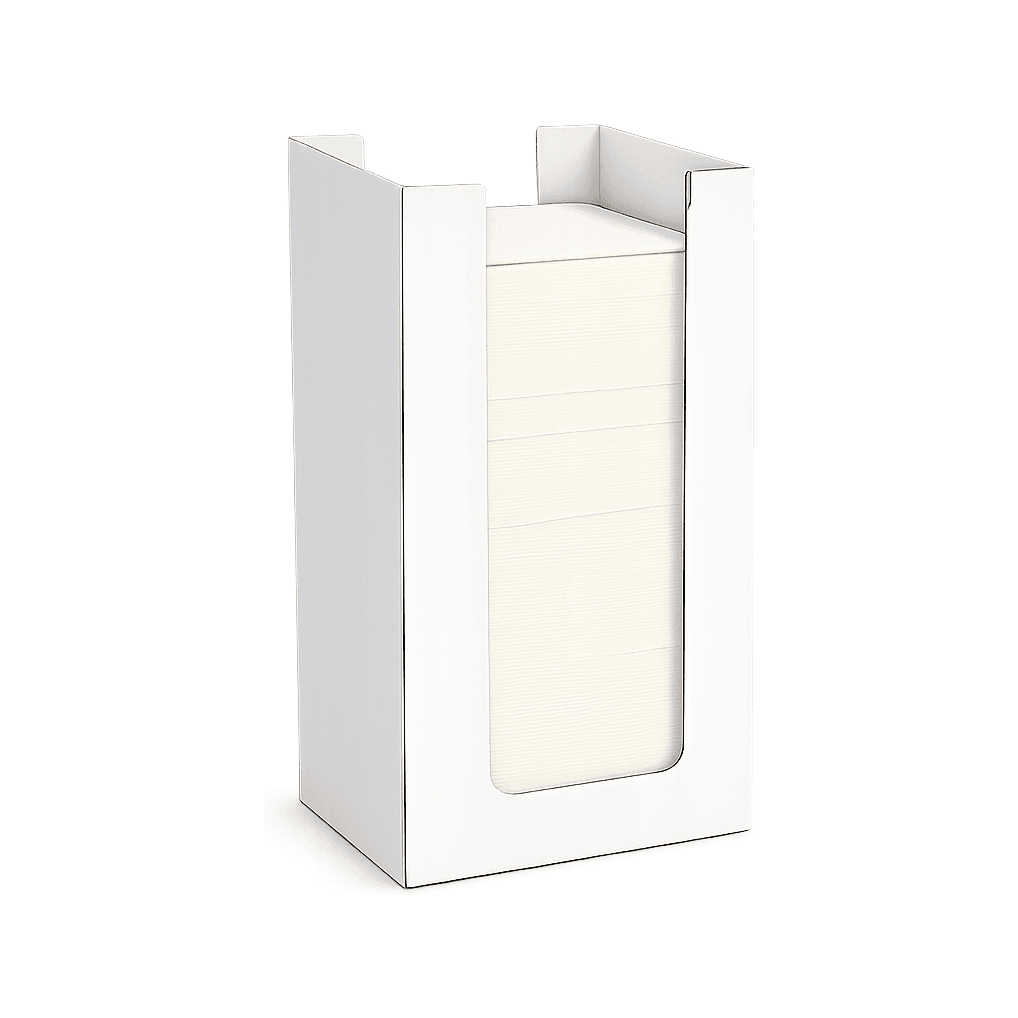
The single-use cardboard dispenser is a complete unit: a cardboard housing with the napkins already inside, ready the moment it is unpacked. No equipment purchase, no mounting, no servicing. An empty unit is swapped for a new one in seconds and goes into paper recycling together with its packaging — there is no plastic and no metal to separate out.
Its natural habitat is serving points that change: seasonal terraces, outside catering, events, food courts, a station wheeled out for peak trade, a leased unit where you would rather not drill into the wall. It also works well where the swap has to be immediate and doable by anyone on shift without training.
A permanent dispenser — wall-mounted or countertop — wins in a different scenario: the serving point has been fixed for years, traffic is high and stable, and you want the counter surface back. In exchange you accept the purchase, the mounting, the cleaning, and refilling mid-service, which is precisely when the team has least time.
The honest summary: single-use cardboard shifts cost from equipment to consumable, and a permanent unit does the reverse. The criterion is not price but the stability of the serving point. If your station might stand somewhere else a year from now, the choice makes itself.
Our version — a cardboard dispenser with 33×33 cm napkins inside — is in the dispenser napkins range.
White or Eco in a dispenser
The 1/8D napkin comes in two variants: white and Eco, made from unbleached, biodegradable paper.
White is the default in quick service, on the forecourt, and anywhere the napkin is simply meant to disappear from view. It communicates nothing, which is the point.
Eco has a stronger position in this category than in most, for a reason that rarely gets said out loud. The entire unit is cardboard: housing and napkins go into the same waste stream with no material separation, no plastic flap and no metal spring to remove first. It is one of the few points in foodservice where an environmental claim needs no asterisk. If you tell guests you are reducing plastic, this product will actually carry that claim.
Worth knowing: none of our napkins — white or Eco — is chlorine-bleached; the difference lies in the bleaching process, not in safety. We cover this in more depth in the article on eco-friendly napkins.
How to measure whether it paid off
The most common assessment error is looking at the invoice. Spend moves with traffic, season and purchase price, so it does not answer the question of whether the dispenser worked.
The only indicator that answers it is napkins per guest.
- Take four weeks before the change: napkins issued divided by guests over that period.
- Repeat for four weeks after the change, at comparable traffic.
- Compare those two numbers and nothing else.
If the indicator has not fallen, do not look for fault in the product — the cause is always one of the three described above. Work through them in order: are units being overpacked, are they swapped at one third of load, do they stand at pickup points rather than on tables. In a multi-site estate, run this per site: the site that broke will not show up in a consolidated figure.
The step-by-step method for demand, buffer stock and seasonality is in how many napkins to order, and the broader disposables cost audit is in how to reduce disposable costs.
Most common mistakes
- Packing the unit as full as it will go. An over-compressed stack resists and adds one crumpled napkin to every withdrawal.
- Swapping only at empty. On the last third the offset stops working and guests reach in for a handful.
- The unit on the table. Guests take a reserve at the start of the meal, before they know how much they need.
- One serving point where there are two pickup points. Guests walk to the far end for napkins and take four so they do not have to walk twice.
- Comparing a dispenser napkin price against a 24×24 cm price. Two different sheets — the comparable one is the classic 33×33 cm.
- Raising the grammage instead of fixing the placement. Thicker paper will not stop a handful being taken from a badly placed unit.
- Judging the outcome from the invoice. Spend moves with traffic; only napkins per guest answers the question.
- Treating the second napkin as waste. Two single-ply sheets are the same paper as one two-ply.
- Rolling out across sites with a briefing instead of a checklist. Briefings do not survive staff turnover; checklists do.
- Topping up a part-used unit. Fresh napkins on a settled stack create a soft middle where the offset disappears — run it down or replace it.
- Writing an instruction nobody can verify. "Keep dispensers adequately stocked" cannot be checked from across the room; "replace below one third" can.
- Auditing from behind the counter. The failure is visible from where the guest stands and nowhere else.
Pre-order checklist
- [ ] Have I walked the guest journey from till to table and counted the pickup points?
- [ ] Does every condiment station have its own unit?
- [ ] Does the team know the replacement point is one third of load, not zero?
- [ ] Does the team know the unit must not be overpacked?
- [ ] Do the units stand at pickup points rather than on tables?
- [ ] Have I measured napkins per guest before the change, so there is a baseline?
- [ ] For greasy items, have I planned two napkins per portion?
- [ ] Are delivery and drive-thru packing counted separately from self-service?
- [ ] Is my serving point stable enough to justify a permanent dispenser — or will it move?
- [ ] Are the three failure modes written into opening, pre-peak and close-down checklists rather than briefed once?
- [ ] Does the standard say explicitly that a part-used unit is never topped up?
- [ ] Have I walked one site as a guest, not as an inspector, before drawing conclusions?
- [ ] Have I chosen white or Eco deliberately, in line with what the site communicates?
Key takeaways
- The offset is the whole mechanism. 1/8D in the N1 system is an eighth-fold with a shifted final panel; the projecting strip gives fingers a grip on exactly one napkin.
- Nothing advances by itself. The stack must keep height and compression — which makes load level an operating parameter, not a detail.
- A dispenser napkin is a full 33×33 cm sheet. The fold changes, the dimension does not.
- The 25–40% reduction is a property of the situation, not the equipment. Overpacking, the last third, and the table instead of the pickup point each cancel it.
- Napkins are served where the guest collects the food, not where the guest eats it.
- More serving points can mean fewer napkins issued, when they remove the need to walk back.
- The second napkin is not waste — two single-ply sheets are 32–38 g/m², the same as one two-ply.
- The choice between single-use cardboard and a permanent unit turns on the stability of the serving point, not on price.
- A standard beats a briefing. Put the three failure modes on checklists that already exist; new tasks fail, new lines survive.
- Never top up a part-used unit — the join between two loads is exactly where the offset stops working.
- Measure napkins per guest, per site, not spend. It is the only number that answers whether the change worked.
> Considering dispensers across your sites? We will walk the guest journey with you, set the number of serving points and match the white or Eco variant to what your brand communicates. Free samples and direct manufacturer pricing — get in touch or see our B2B wholesale offer. Ready-to-use cardboard dispensers with napkins inside are in the dispenser napkins range, and the full format line-up is in catering napkins.